Forklift Battery Runtime Calculator: Capacity & Working Hours Guide
Related Lithium Forklift Battery Solutions
Ready to size the right pack for your truck? Browse our drop-in lithium batteries by voltage and get a custom quote for your fleet.
- 24V Forklift Batteries - Toyota, Crown, Big Joe replacements
- 48V Forklift Batteries - counterbalance trucks, 400-1000 Ah
- 80V Forklift Batteries - heavy-duty multi-shift operations
- Electric Pallet Jack Batteries - 24V/48V lithium upgrades

Learn forklift battery runtime calculation and how to calculate forklift battery runtime and capacity requirements for efficient warehouse operations
Unexpected forklift downtime because the battery dies mid‑shift… or wasting money on oversized packs that never get fully used. Sound familiar?
If you manage an electric fleet, getting forklift battery runtime calculation and capacity sizing wrong isn’t a small mistake—it hits productivity, labor, and operating costs every single day.
In this guide, you’ll see exactly how to calculate forklift battery runtime and capacity requirements using clear formulas, real‑world duty cycle assumptions, and practical examples. You’ll learn how to turn specs like voltage, amp-hours (Ah), kWh, depth of discharge (DoD), and average power consumption into a precise number of hours your truck can actually run.
We’ll also compare lead-acid vs lithium forklift battery runtime, show you how opportunity charging changes the math for multi‑shift operations, and give you a simple framework to right‑size your forklift battery for your warehouse—without guesswork.
If you want your trucks to finish every shift without sweating the battery gauge, keep reading.
Understanding Forklift Battery Basics
If I want reliable forklift battery runtime, I need to understand a few core terms and how they work together in real operations.
Key Forklift Battery Terms (Voltage, Ah, kWh, DoD, Duty Cycle)
-
Voltage (V)
The battery’s “pressure.” Common forklift battery voltages are 24V, 36V, 48V, 80V.
Higher voltage allows the truck to deliver the same power with lower current, which can improve efficiency and reduce heat. -
Amp-hours (Ah)
The capacity rating of the battery. A 48V 600Ah battery can (in theory) deliver 600 amps for 1 hour or 100 amps for 6 hours.
This is the number most people look at first when they calculate forklift battery runtime. -
Kilowatt-hours (kWh)
The energy content of the battery:
kWh = (Voltage × Ah) ÷ 1000
For example, 48V × 600Ah ÷ 1000 ≈ 28.8 kWh.
kWh is more accurate when comparing different voltages and technologies. -
Depth of Discharge (DoD)
How much of the battery capacity I actually use before recharging, expressed as a percentage.- Lead-acid: commonly limited to 70–80% DoD
- Lithium-ion: often safely usable to 80–90% DoD
DoD directly impacts usable forklift battery capacity and runtime.
-
Duty Cycle
How hard the forklift works over time: mix of lifting, traveling, idling, and peaks.
A heavy-duty cycle with constant lifting and long travel will draw more amps and reduce electric forklift battery life hours.
How Voltage and Ah Affect Forklift Battery Runtime
- Higher Ah rating = more stored energy = longer potential runtime, assuming the same duty cycle and depth of discharge.
- Higher voltage lets the forklift use lower current (amps) for the same power. That can:
- Reduce cable and connector losses
- Improve overall forklift battery efficiency
- For comparing runtime, I look at total kWh (V × Ah) and the average power demand of the truck.
Lead-Acid vs Lithium Forklift Battery Runtime
-
Lead-acid forklift batteries
- Usable DoD typically 70–80%
- Voltage drops more as the battery discharges
- Runtime falls faster at high discharge rates (Peukert effect)
- Requires equalization charging and regular maintenance
-
Lithium forklift batteries
- Usable DoD often 80–90%
- Flatter voltage curve, more consistent performance through the shift
- Better efficiency and less impact from high discharge rates
- Ideal for multi-shift and opportunity charging operations
In the same kWh size, lithium usually delivers more usable runtime, especially in demanding duty cycles or multi-shift fleets.
Why Runtime Is Not Just Ah ÷ Amps
On paper, forklift battery runtime looks simple:
Runtime (hours) = Ah / average amps
In reality, this overestimates runtime because it ignores:
- Peukert’s effect in lead-acid: the faster I discharge, the less usable capacity I get.
- Voltage sag under load: high currents reduce effective power and forklift performance.
- Temperature effects: cold storage and freezer use reduce capacity and increase internal resistance.
- Battery age: an older battery may have lost 15–30% of its original capacity.
- Inefficiencies in the truck’s electrical system, hydraulics, and controllers.
That’s why real forklift battery runtime is always less than the simple Ah ÷ amps calculation.
Usable Capacity vs Rated Capacity in Real Operations
The label on the battery is rated capacity. What I can actually use in my warehouse is usable capacity.
Usable capacity is reduced by:
- DoD limits (e.g., 80% for lead-acid to protect life)
- System efficiency losses (truck, cables, controller, BMS)
- Temperature (especially in cold storage)
- High discharge rates and aggressive duty cycles
- Battery degradation over years of use
So while a 48V 600Ah forklift battery is rated at 28.8 kWh, I might plan for only 18–22 kWh of usable energy in real-world conditions, depending on chemistry and environment.
Understanding this gap between rated and usable forklift battery capacity is the foundation for accurate forklift battery runtime calculation and safe capacity sizing.
Core formulas for forklift battery runtime
Getting forklift battery runtime right starts with a few simple formulas. Once you lock these in, sizing and planning becomes much easier.
Forklift battery runtime formula using Ah
If you know the battery amp-hour rating and average current draw, use:
Runtime (hours) = (Battery capacity (Ah) × usable DoD) ÷ average amp draw (A)
Example:
- 48V battery, 600 Ah
- Usable DoD = 80% (0.8)
- Average draw = 90 A
Runtime ≈ (600 × 0.8) ÷ 90 = 5.3 hours
This Ah-based forklift battery runtime formula works well if you already know your average current in amps.
Forklift battery runtime formula using kWh
If you work more with power (kW) and energy (kWh), use:
Runtime (hours) = usable Wh ÷ average power (W)
Steps:
- Battery energy (Wh) = Voltage × Ah
- Usable Wh = Battery Wh × DoD × system efficiency
- Runtime = usable Wh ÷ average power draw (W)
Example:
- 48V, 600 Ah → 48 × 600 = 28,800 Wh (28.8 kWh)
- DoD = 80% (0.8)
- System efficiency (truck + battery + controller) ≈ 85% (0.85)
- Average power = 5,000 W (5 kW)
Usable Wh = 28,800 × 0.8 × 0.85 ≈ 19,584 Wh
Runtime ≈ 19,584 ÷ 5,000 ≈ 3.9 hours
This forklift battery kWh calculation is better for fleet energy planning and comparing different voltages like 48V lithium forklift batteries.
Calculating usable forklift battery capacity
You never use 100% of the rated capacity in real life. To get usable capacity:
- Usable Ah = rated Ah × allowed DoD × battery efficiency
- Usable kWh = (V × Ah ÷ 1000) × DoD × system efficiency
Typical values:
- Lead-acid: DoD 70–80%, overall efficiency 75–85%
- Lithium: DoD 80–95%, overall efficiency 90–95%
Discharge rate and Peukert’s effect
For lead-acid, the faster you pull amps, the less capacity you actually get (Peukert’s effect):
- Heavy, continuous lifting = higher current = shorter real runtime
- Light, mixed duty = closer to rated capacity
Lithium batteries are far less sensitive to discharge rate, so runtime is more stable even with high peak loads.
When to use Ah-based vs kWh-based runtime
Use Ah-based runtime when:
- You know the truck’s average current draw (A)
- You’re comparing batteries of the same voltage
Use kWh-based runtime when:
- You’re planning multi-shift energy use
- You’re comparing different voltages (24V, 36V, 48V) or chemistries
- You want to translate forklift energy consumption per hour directly into kWh per shift
Both methods point to the same answer; kWh is just cleaner for fleet and warehouse energy planning, while Ah is more practical at the single-truck level.
Forklift Power Consumption and Duty Cycle
What forklift duty cycle really means
When we talk about forklift duty cycle, we’re talking about how hard and how often the truck actually works during a shift, not just how many hours it’s turned on.
Think of it as the mix of:
- Lifting time (pump motor on)
- Driving time (traction motor on)
- Idling time (key on, minimal draw)
- Peak events (full load lifts, ramps, fast travel)
A truck that’s key-on for 8 hours but only “working hard” 30–40% of the time has a light/medium duty cycle. If it’s lifting and driving under load most of the shift, that’s heavy duty – and your forklift battery runtime drops fast.
Typical amp draw ranges by application
Actual current varies by model, load, and voltage, but these ranges are a good starting point for electric forklift battery life hours:
-
Light-duty warehouse use
- Occasional light loads, short runs
- Average draw: 40–80 A on a 48V truck
- Suitable for one easy shift with standard lead-acid
-
Medium-duty, typical DC warehouse
- Regular pallet moves, mixed lift heights
- Average draw: 80–150 A
- Common for standard 8-hour shifts with a correctly sized battery
-
Heavy-duty, multi-shift / high-throughput
- Constant loading, high stacking, long travel, ramps
- Average draw: 150–250+ A
- Often needs larger capacity, opportunity charging, or lithium to keep runtime
These numbers help when you calculate forklift battery Ah requirements for your site.
How to estimate forklift amp draw
If you don’t have live data or telematics, you can still get a solid estimate by combining specs + real-world usage:
-
Start with the truck spec sheet
- Look for rated power (kW) or traction + pump motor power.
- Convert kW to amps at your battery voltage:
- Amps ≈ (kW × 1000) ÷ battery voltage
- Example: 10 kW at 48V → ≈ 10,000 ÷ 48 ≈ 210 A at full load.
-
Apply a realistic duty factor
- Light-duty: use 25–35% of that full-load current
- Medium-duty: use 35–60%
- Heavy-duty: use 60–80%+
-
Validate on the floor
- Watch a full hour of typical work.
- Log how often the truck:
- Lifts close to rated load
- Travels at full speed
- Climbs ramps
- Adjust your average current up or down based on this.
Over time, I recommend adding battery monitoring or telematics so your forklift energy consumption per hour is based on actual data, not guesswork.
What really pushes forklift power consumption up
Even if two sites use the same truck and battery, the duty cycle can make runtime very different. Key factors that increase forklift energy consumption per hour:
-
Load weight
- Closer to rated capacity = higher amp draw.
- Regularly moving 1.5–2.0 tons vs light pallets can easily bump average draw by 20–40%.
-
Lift height
- High stacking (7–12+ m) means the pump motor works harder and longer.
- Frequent high lifts dramatically cut runtime compared to low-level pallet moves.
-
Travel distance and speed
- Long aisle runs and aggressive acceleration mean more traction energy.
- High-speed, high-throughput operations often require bigger kWh or lithium.
-
Ramps and docks
- Climbing ramps is one of the biggest current spikes.
- Repeated ramp work can turn what looks like a “medium-duty” site into true heavy-duty from a battery perspective.
If you size forklift battery capacity without considering these, you’ll underestimate the usable forklift battery capacity you need.
Temperature, cold storage, and forklift battery performance
Ambient temperature has a huge effect on forklift battery runtime:
-
Standard warehouse (20–30°C)
- Both lead-acid and lithium perform near rated capacity.
- You can use standard forklift battery kWh calculation with minor derating.
-
Cold storage (0 to -20°C)
- Lead-acid:
- Capacity can drop 20–40%.
- Voltage dips earlier, runtime shortens, and charging needs more time.
- Lithium:
- Better cold performance but still needs proper BMS and heating strategy.
- Runtime loss is smaller, but charging below 0°C must be controlled.
- Lead-acid:
For freezer and cold storage applications, I always recommend:
- Derating capacity in your calculations
- Planning extra kWh or a second battery
- Using robust chargers sized for your duty cycle – for example, pairing high-demand fleets with the right industrial battery chargers to recover energy fast during breaks
Get the duty cycle and conditions right first; then your forklift battery capacity sizing and runtime estimates will be much closer to reality.
Step-by-Step Forklift Battery Runtime Calculation
1. Define your shift length and operating hours
Start with the basics:
- How many hours per shift do you run the forklift? (e.g. 8 hours)
- How many shifts per day? (single-shift or multi-shift)
- How many days per week?
This total operating time tells you how many hours of electric forklift battery life you must reliably cover without running out of power mid-shift.
2. Estimate average power or amp draw per hour
Next, break down how hard the truck actually works. You can use:
- Manufacturer data (average forklift energy consumption per hour in kW)
- Telematics or charger logs from your current fleet
- A simple estimate based on duty cycle (light / medium / heavy use)
As a quick rule of thumb:
- Light duty: 20–40 A average
- Medium duty: 40–80 A average
- Heavy duty: 80–150+ A average
If your forklift specs list kW instead of amps, convert to amps:
Amps ≈ kW × 1000 ÷ battery voltage
3. Calculate usable battery capacity (DoD + efficiency)
Rated capacity is not the same as usable capacity. To calculate usable forklift battery capacity:
Usable Ah = Rated Ah × allowed depth of discharge (DoD) × system efficiency
Example:
- 48V, 600 Ah lead-acid battery
- DoD limit: 80% (0.8)
- System efficiency (controller, cables, motor): ~90% (0.9)
Usable Ah = 600 × 0.8 × 0.9 = 432 Ah usable
For kWh-based sizing:
- Rated kWh = Voltage × Ah ÷ 1000
- Usable kWh = Rated kWh × DoD × efficiency
This is the capacity you can actually plan on for runtime, especially for multi-shift forklift battery needs.
4. Compute expected forklift battery runtime
Now use a simple forklift battery runtime formula:
-
Ah method:
Runtime (hours) = Usable Ah ÷ average amp draw -
kWh method:
Runtime (hours) = Usable Wh ÷ average power draw (W)
(Usable Wh = Usable kWh × 1000)
Example using Ah:
- Usable capacity: 432 Ah
- Average draw: 54 A
Runtime = 432 ÷ 54 ≈ 8 hours
For electric pallet trucks or stackers, you can use the same approach and then match capacity with suitable packs like our electric pallet jack batteries for consistent runtime.
5. Add safety margins for real-world conditions
Never size to the exact number. Real operations are messy. Add a buffer for:
- Peak current draw (lifting full loads, ramps, acceleration)
- Battery aging and capacity fade (especially lead-acid)
- Temperature losses (cold storage environments)
- Operator behavior (harsh driving, long travel distances)
Typical safety margin: 20–30% above your calculated need.
This keeps your forklift battery depth of discharge within safe limits and reduces the risk of mid-shift failures.
Simple Runtime Planning Checklist
- [ ] Confirm shift length and daily hours
- [ ] Estimate average amps / kW from real usage
- [ ] Apply DoD and efficiency to get usable Ah or kWh
- [ ] Run the runtime formula (Ah or kWh based)
- [ ] Add 20–30% buffer for peaks, aging, and environment
Follow this process and you can calculate forklift battery Ah requirements accurately and pick a battery that actually survives your shifts, not just on paper.
How to Size Forklift Battery Capacity Requirements
Sizing forklift battery capacity the right way is the difference between smooth shifts and constant “battery low” alarms. Here’s a fast, practical way to do it.
1. Identify Single-Shift vs Multi-Shift Needs
Start with how your trucks actually run:
- Single-shift: 6–8 hours use per day
- Extended shift: 8–12 hours use per day
- Multi-shift: 16–24 hours with short breaks for charging or battery change
Ask yourself:
- How many hours per truck per day are key-on?
- Do operators use opportunity charging (fast top-ups during breaks)?
- Is battery change-out possible, or must one battery cover the whole day?
2. Calculate Daily Energy Demand (kWh)
Use a simple rule-of-thumb to estimate daily forklift energy consumption:
- Light duty: 3–5 kWh per hour
- Medium duty: 5–8 kWh per hour
- Heavy duty: 8–12+ kWh per hour
Formula (per forklift):
Daily kWh = Average kW draw × operating hours
Example
| Use case | Avg power (kW) | Hours/day | Daily demand (kWh) |
|---|---|---|---|
| Medium warehouse | 6 kW | 8 h | 48 kWh |
Multiply by the number of forklifts to get fleet kWh per day.
3. Convert kWh to Required Ah (at a Given Voltage)
Once you know the kWh, convert it to battery Ah based on system voltage:
Formula:
Ah required = (Daily kWh × 1000) ÷ Battery voltage
Example (48V system, 48 kWh/day):
Ah = 48,000 Wh ÷ 48 V ≈ 1000 Ah
This is the theoretical amp-hour rating before you adjust for depth of discharge and losses.
4. Adjust for Depth of Discharge and Charger Efficiency
You can’t use 100% of the rated capacity, and you lose some energy in charging.
Typical assumptions:
- Lead-acid forklifts
- Usable DoD: 60–80%
- System + charger efficiency: 75–85%
- Lithium-ion forklifts
- Usable DoD: 80–95%
- System + charger efficiency: 90–95%
Usable energy formula:
Usable kWh = Rated kWh × DoD × efficiency
Sizing example – 48V, lead-acid:
- Target usable energy needed: 48 kWh
- Assume 80% DoD and 80% efficiency:
Rated kWh = 48 kWh ÷ (0.8 × 0.8) ≈ 75 kWh
Ah = (75,000 Wh ÷ 48 V) ≈ 1560 Ah
So instead of 1000Ah, you realistically need ~1500–1600Ah in lead-acid for the same runtime.
For large fleets, pair the right battery with matched lead-acid or lithium forklift chargers so you don’t waste capacity on poor charging: for example, check our optimized lead-acid chargers for industrial forklifts or high-efficiency lithium chargers for multi-shift lithium fleets.
5. Compare Battery Sizes and Chemistries vs Runtime Targets
Now compare real options:
| Option | Typical DoD | Efficiency | Best for |
|---|---|---|---|
| Lead-acid 48V 750Ah | 60–70% | 75–85% | Light/medium single-shift |
| Lead-acid 48V 1000–1500Ah | 70–80% | 75–85% | Heavy single-shift, some 2-shift |
| Lithium 48V 400–700Ah | 80–95% | 90–95% | 2–3 shifts with opportunity charge |
Key checks:
- Does the battery cover your longest shift with 20–30% reserve?
- Do you have enough charging power in breaks to support multi-shift lithium?
- Is it cheaper to buy bigger batteries, or invest in faster chargers + opportunity charging?
If you’re not sure, share your voltage, hours, and duty profile and I can help you choose the right Ah rating and chemistry for your runtime target.
Real-World Forklift Battery Runtime Examples
1) 48V Lead-Acid Battery for an 8-Hour Single Shift
For a standard warehouse truck on a single shift, a common setup is:
- Battery: 48V, 750Ah lead-acid
- Rated energy: 48V × 750Ah ≈ 36 kWh
- Usable capacity (at 80% depth of discharge for lead-acid):
- 36 kWh × 0.8 ≈ 28.8 kWh usable
If the forklift’s average energy consumption is around 3.5 kW:
- Runtime (hours) ≈ 28.8 kWh ÷ 3.5 kW ≈ 8.2 hours
In reality, I plan for 6.5–7.5 hours of electric forklift battery life to allow for:
- Peak loads
- Battery aging
- Operator habits
That’s usually enough for a single 8-hour shift with breaks and idle time, especially with a properly sized 48V industrial pack like those in our 48V battery product range on the Xichá forklift battery catalog.
2) 48V Lithium-Ion for 2–3 Shifts with Opportunity Charging
For multi-shift operations, lithium shines because of higher usable capacity and fast charging. Example:
- Battery: 48V, 560Ah lithium-ion
- Rated energy: 48V × 560Ah ≈ 26.9 kWh
- Usable capacity (up to 90% DoD for lithium):
- 26.9 kWh × 0.9 ≈ 24.2 kWh usable
If the truck draws an average of 4 kW in a busy warehouse:
- Base runtime ≈ 24.2 kWh ÷ 4 kW ≈ 6 hours
With opportunity charging during breaks:
- 1–1.5 hours of total charging time (lunch + coffee breaks) at a 10 kW charger can add:
- ~10–15 kWh back into the pack
- That’s another 2.5–4 hours runtime
Net result:
- You can realistically cover 2–3 shifts with one lithium forklift battery and a planned opportunity charging strategy, instead of swapping heavy lead-acid batteries.
3) Forklift Battery Capacity in Freezer and Cold Storage
Cold storage changes everything. Capacity drops and energy consumption rises. Typical effects:
- At –20°C / –4°F:
- Lead-acid usable capacity can drop 20–30%
- Lithium-ion usually drops less, around 10–20%, depending on BMS and cell type
Example with a 48V, 620Ah lead-acid battery in a freezer:
- Rated energy: 48V × 620Ah ≈ 29.8 kWh
- Normal usable capacity (80% DoD): 29.8 × 0.8 ≈ 23.8 kWh
- At –20°C, assume 25% capacity loss: 23.8 × 0.75 ≈ 17.9 kWh usable
If the truck burns 4 kW in cold conditions:
- Runtime ≈ 17.9 ÷ 4 ≈ 4.5 hours
So for freezer operations, I usually:
- Upsize the battery (higher Ah)
- Choose lithium with low-temperature performance if budgets allow
- Plan for shorter runtime per charge and tighter charging schedules
You can also look for dedicated cold storage battery solutions in our battery product lineup, which are designed for low-temperature performance and consistent forklift battery runtime.
4) Attachments and Extra Loads Change Runtime Fast
Forklift energy consumption per hour jumps as soon as you add:
- Sideshifters or fork positioners
- Clamps (paper, bale, drum)
- Large platforms or double-deep attachments
These add:
- Extra weight (higher travel energy)
- Hydraulic load (higher pump current draw)
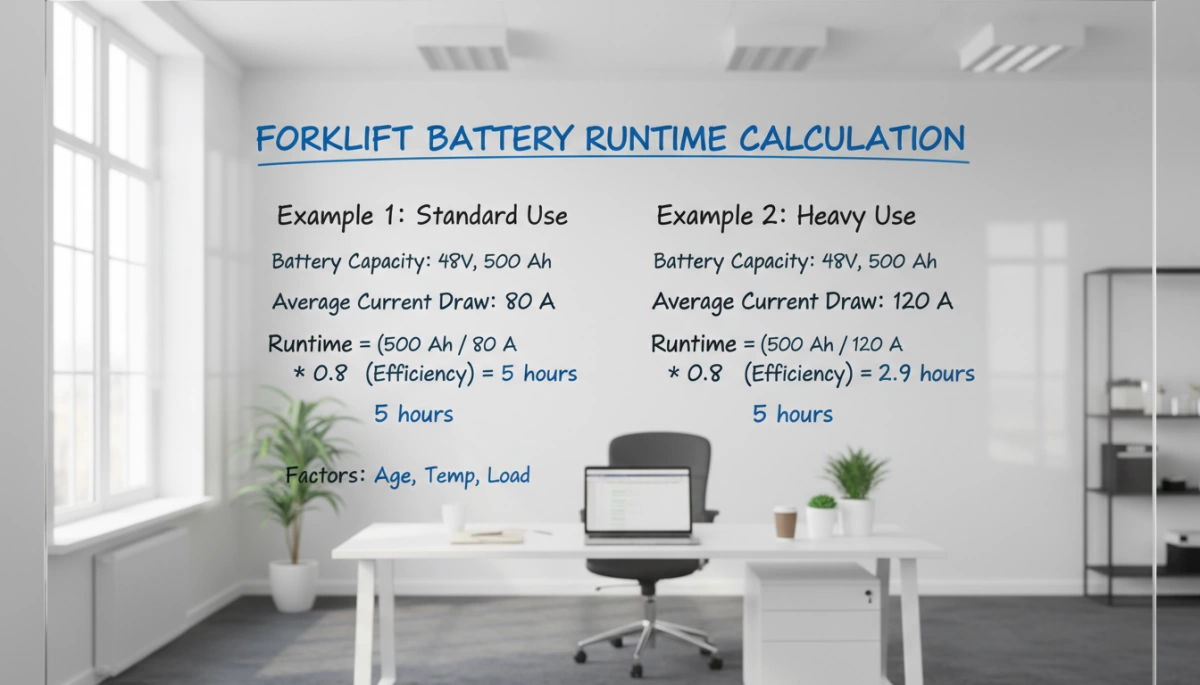
Example: If a bare truck averages 80A, adding a clamp might push that to 110–130A.
Using the basic forklift battery runtime formula:
- Runtime (hours) ≈ (usable Ah) ÷ (average A)
If you have 600Ah usable:
- Without attachment: 600 ÷ 80 ≈ 7.5 hours
- With attachment: 600 ÷ 120 ≈ 5 hours
That’s a 30–40% runtime hit, just from the attachment. Whenever someone adds attachments, I immediately re-check the forklift battery capacity sizing.
5) Common Forklift Battery Sizing Mistakes (And How to Avoid Them)
Here are the runtime mistakes I see most often when people calculate forklift battery Ah requirements:
-
Using “nameplate” runtime only
- Only looking at Ah rating and ignoring DoD limits, Peukert’s effect, and efficiency losses.
- Fix: Always calculate usable capacity, not just rated Ah.
-
Underestimating duty cycle
- Assuming “light duty” while running constant heavy lifting, long runs, and ramps.
- Fix: Use real amp draw data from the manufacturer or telematics, not guesswork.
-
Ignoring temperature
- Using the same runtime assumptions for ambient and cold storage.
- Fix: Apply temperature derating (especially in freezers).
-
Not planning for battery aging
- New batteries deliver full runtime; 2–3 years in, they don’t.
- Fix: Add 15–25% capacity margin when sizing for multi-year use.
-
No room for opportunity charging
- Especially in multi-shift setups.
- Fix: Plan clear charging windows and make sure charger power matches your runtime needs.
If you avoid these mistakes and run the numbers clearly with the forklift battery runtime formulas above, you’ll get a battery setup that actually survives your shifts instead of dying in the middle of a job.
Lead-acid vs lithium forklift battery runtime
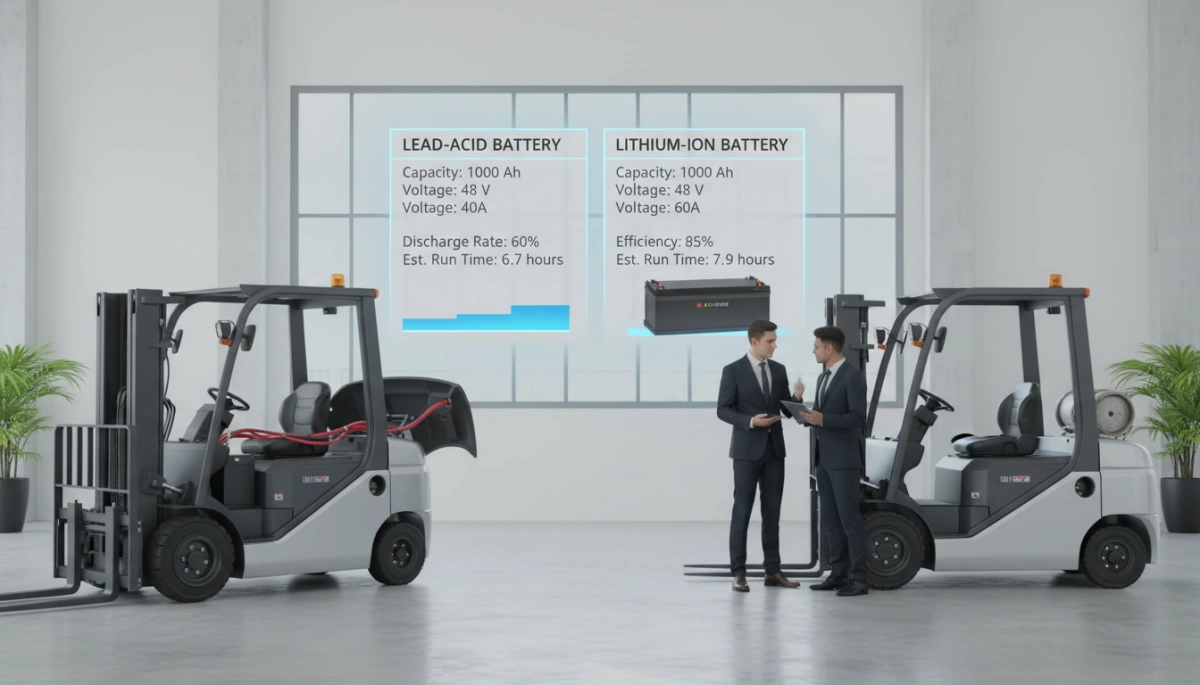
When we talk about forklift battery runtime, lead-acid and lithium-ion behave very differently in real warehouses, not just on paper.
Runtime differences in real use
- A typical lead-acid forklift battery delivers its best runtime only when new, at moderate temperature, and under light–medium duty. Voltage drops as it discharges, so trucks often feel “weak” in the second half of the shift.
- A lithium forklift battery keeps a flatter voltage curve, so you get more consistent electric forklift battery life hours across the whole discharge. In practice, lithium usually gives 10–30% more usable runtime from the same rated kWh because of higher efficiency and less voltage sag.
Depth of discharge and usable capacity
Depth of discharge (DoD) is the main runtime limiter:
- Lead-acid: to avoid killing the battery early, you normally use max 80% DoD, and many fleets stay closer to 60–70% usable capacity day-to-day.
- Lithium: quality packs are designed for 80–90% DoD without hurting cycle life, so your usable forklift battery capacity is much closer to the sticker rating.
Same Ah, different reality: a 48V 600Ah pack
- Lead-acid at 70% DoD → ~20 kWh usable
- Lithium at 90% DoD → ~26 kWh usable
That gap is exactly what you feel in runtime and capacity sizing.
Charging time, opportunity charging, multi-shift
Charging is where lithium wins big for multi-shift forklift battery needs:
- Lead-acid
- 7–10 hours full charge + cool-down
- Battery swaps often needed for 2–3 shifts
- Opportunity charging is limited; partial charges can shorten life if abused
- Lithium
- 1–2 hours to high SOC with high‑power chargers
- Designed for opportunity charging during breaks, loading, driver changeovers
- One battery can cover 2–3 shifts if you build charging into the workflow
If you’re planning high-utilization fleets, it’s critical to match charger power, charge windows, and duty cycle. For reference, you can see how we configure high‑duty lithium forklift battery systems in our lithium-ion forklift battery product range.
Total cost of ownership vs upfront cost
- Lead-acid
- Lower purchase price
- Higher labor (watering, cleaning, swaps), ventilation, and battery room costs
- Shorter cycle life, especially under deep discharge or heat
- Lithium
- Higher upfront price
- Lower energy losses (higher efficiency), less maintenance, longer life
- Often no battery change room, less downtime, more productive hours per truck
In many global operations running 2+ shifts, lithium’s total cost of ownership beats lead-acid within 2–4 years because of saved labor, fewer batteries, and higher uptime.
When lead-acid still makes sense
Stick with lead-acid forklift batteries when:
- You run light, single-shift work with long idle windows
- Capex is tight and energy/labor costs are low
- You already have a lead-acid battery room and trained maintenance staff
- Your trucks don’t need long runtime and you can live with mid-shift changes
Switch to lithium for runtime when:
- You run medium to heavy duty, 1.5–3 shifts per day
- You want to avoid battery swaps and maximize truck availability
- You operate in cold storage or high-throughput distribution where consistent power matters
- You’re ready to treat chargers and battery management systems for forklifts as part of your core infrastructure
If you’re unsure which way to go for your runtime targets, you can share your voltage, Ah, and shift pattern with us, and we’ll size a forklift battery capacity and charging setup that fits your operation.
Maximizing Forklift Battery Runtime and Life
Keeping forklift battery runtime high and battery life long comes down to smart charging, simple maintenance, and disciplined operation. Here’s how I approach it in real fleets.
Best Charging Practices for Longer Forklift Battery Runtime
- Charge in planned windows, not randomly.
- Lead-acid: full charge cycles, avoid “grazing” charges under 20–30 minutes.
- Lithium: opportunity charging is fine and ideal for multi‑shift runtime.
- Stay within healthy depth of discharge (DoD):
- Lead-acid: plan runtime around 70–80% DoD, don’t routinely run below 20–30% State of Charge.
- Lithium: 80–90% DoD is usually safe thanks to BMS protection.
- Use the right charger power and profile.
Fast charging a battery that isn’t rated for it will cut battery life and degrade runtime. - Keep batteries cool and ventilated.
High temperature accelerates aging and reduces usable forklift battery capacity.
If you need help matching chargers and batteries, we design complete forklift battery systems and chargers under our own brand, detailed on our lithium industrial battery solutions page.
Basic Battery Maintenance Routines (Lead‑Acid vs Lithium)
- Lead-acid forklift batteries:
- Check and top up water on schedule (after charging, with distilled water).
- Keep terminals clean, dry, and corrosion‑free.
- Equalize charge as recommended to balance cells and protect runtime.
- Lithium forklift batteries:
- Rely on the BMS for balancing and protection—no watering required.
- Keep firmware and monitoring apps up to date.
- Inspect connectors and cables regularly.
Simple routines like these can easily add 1–2 years to effective electric forklift battery life hours.
Operator Habits That Waste or Save Battery Energy
Habits that kill forklift battery runtime:
- Aggressive acceleration and braking.
- Traveling with mast raised or unnecessary lifting.
- Long idling with key on and hydraulics powered.
- Unnecessary use of lights, fans, and extra electrical loads.
Habits that extend runtime:
- Smooth driving and planned routes.
- Lowering loads when traveling long distances.
- Using “eco” modes or reduced speed when possible.
- Parking and switching off during breaks.
Training operators on these basics often boosts runtime by 10–20% without changing the battery.
Using Telematics to Track Real Runtime and Usage
Telematics and smart BMS data turn guesswork into real numbers:
- Track forklift energy consumption per hour by truck, shift, and operator.
- See depth of discharge, charge cycles, and actual forklift duty cycle.
- Identify high‑drain trucks or misuse (e.g., long idle time, aggressive handling).
- Use historical data to size forklift battery capacity correctly for new units.
Most modern lithium packs we ship include integrated monitoring and can be tied into fleet telematics for forklift battery runtime analysis.
Planning Charging Schedules to Prevent Mid‑Shift Failures
To avoid mid‑shift battery failures, plan around your actual energy profile:
- Map out shift length, breaks, and charger availability.
- For lead-acid:
- Design for a full shift on one charge plus a safety margin (10–20%).
- Schedule full overnight charges; use spare batteries for multi‑shift.
- For lithium:
- Use breaks and lunch for opportunity charging to cover 2–3 shifts.
- Make sure charger power (kW) matches your runtime and break windows.
- Build in extra buffer for cold storage, heavy attachments, and aging (capacity loss over years).
We build forklift battery systems specifically to meet these real-world runtime and charging patterns, which you can see in our forklift and industrial battery product range.
Forklift Battery Runtime FAQ
How many hours of forklift battery runtime should I plan per shift?
For most electric forklifts, I plan runtime based on real usable capacity, not the label:
- Single shift (8 hours):
- Lead‑acid: target 5–6 hours of actual drive/lift time (the rest is breaks, idle, loading).
- Lithium: usually 6–7+ hours usable thanks to higher depth of discharge (DoD) and efficiency.
- Multi‑shift:
- Either battery swaps (lead‑acid) or opportunity charging (lithium) during breaks.
As a rule, I size runtime so the truck never drops below 20% SOC for lead‑acid and 10–20% for lithium by end of shift.
What happens if a forklift battery is undersized?
If the forklift battery capacity is too low for your duty cycle:
- You’ll see voltage sag, slow lifts, and poor acceleration.
- Operators will rush charging (short, partial charges) which kills lead‑acid life.
- Mid‑shift shutdowns increase downtime and labor cost.
- Batteries run hotter and cycle deeper, shortening forklift battery life hours.
Long term, an undersized battery costs more in extra batteries, repairs, and lost productivity than buying the right capacity up front.
Is a higher‑capacity forklift battery always better?
Using a higher‑capacity battery than needed can be good, but with limits:
Pros:
- More usable forklift battery capacity and longer runtime.
- Shallower cycles → longer battery lifespan.
- Better margin for peak loads, ramps, cold storage, and aging.
Cons:
- Higher upfront cost and heavier weight (may affect truck rating).
- Overkill capacity might never be used in light‑duty or short‑shift operations.
My rule: size forklift battery Ah so you end a normal day around 30–40% SOC, not 70–80% and not close to zero.
How do temperature and environment change runtime calculations?
Temperature has a huge impact on forklift battery runtime:
- Cold storage / freezer (‑20°C to ‑30°C):
- Lead‑acid can lose 30–40% usable capacity.
- Lithium with proper heating can still lose 10–20%, but does better overall.
- Very hot warehouses (>35°C):
- Runtime looks OK short term, but battery life drops fast.
When I calculate forklift battery runtime for cold environments, I:
- Apply a capacity derating factor (often 20–40%).
- Favor lithium‑ion with integrated heaters for stable runtime.
- Add extra kWh buffer so the truck still finishes the shift.
How do charger power and charging windows affect runtime planning?
Charger power and charging windows decide how much energy you can put back between shifts:
- Look at charger kW (power) and available charging hours:
- Energy returned ≈ charger kW × charging hours × charger efficiency.
- For opportunity charging forklift batteries (especially lithium):
- Use every break, lunch, changeover as a charging window.
- Multiple short, fast charges can fully cover a 2–3 shift operation.
When I plan forklift battery runtime and capacity:
- I calculate daily kWh demand per truck.
- Check total kWh the chargers can deliver per day.
- Make sure charger power + charging windows ≥ daily energy use with a safety margin.
If the math doesn’t work, you either need more charger power, longer charging windows, or higher battery capacity.
Forklift Battery Maintenance Checklist for Longer Service Life
Warehouse Battery Charging Optimization for Multi Shift Operations