Forklift Battery Maintenance Checklist for Longer Service Life

Forklift battery maintenance checklist for longer service life with daily weekly monthly steps safety tips and charging best practices.
Understanding Forklift Battery Basics
If your forklifts don’t run, nothing moves. In most warehouses I see, battery problems cause more downtime than the trucks themselves. That’s why a clear forklift battery maintenance checklist is not “nice to have” – it’s how you protect uptime, safety, and budget.
How Lead-Acid Forklift Batteries Work
Most electric forklifts still run on lead‑acid forklift batteries. These are deep‑cycle industrial batteries built to deliver steady power over a full shift.
In simple terms:
- Each battery is made of cells filled with electrolyte (sulfuric acid + water).
- Inside each cell, lead plates react chemically to store and release energy.
- When you discharge the battery during a shift, lead sulfate builds up on the plates.
- When you charge it correctly, that sulfate is reversed, and the battery is ready for the next run.
Daily operations are hard on these batteries: long shifts, heavy loads, and hot environments all accelerate wear. Good lead acid forklift battery care keeps that chemical process under control so you get consistent runtime and safe performance.
Main Types of Forklift Batteries
You’ll mainly see three battery types in modern fleets:
-
Flooded lead-acid (FLA) – Traditional industrial batteries
- Require regular watering, electrolyte level checks, and equalization charges
- Need the most maintenance but are proven, reliable, and cost‑effective
-
AGM / Gel lead-acid – Sealed lead-acid options
- Minimal watering (often none), but still need proper charging best practices
- More sensitive to overcharging and heat
-
Lithium-ion – Newer technology in many global operations
- Very low routine maintenance
- Require correct charger settings for forklifts and strict temperature monitoring
If you run flooded lead-acid batteries (most warehouses do), you absolutely need a clear forklift battery daily checklist and a defined forklift battery watering schedule. These are the batteries that fail fastest when maintenance is skipped.
What Shortens or Extends Battery Lifespan
The same few habits decide whether a battery lasts 3 years or 7+ years:
Things that kill batteries early:
- Deep discharges below ~20% state of charge every day
- Opportunity charging all day with the wrong settings
- Inconsistent watering – running low on electrolyte or overfilling cells
- High battery temperature during charging and use
- Letting acid, dirt, and corrosion build up on tops and terminals
- Skipping equalization charges on flooded batteries
Things that extend forklift battery lifespan:
- Keeping discharge in the 20–80% range when possible
- Following correct forklift battery charging best practices
- Sticking to a tight forklift battery watering schedule with deionized or distilled water
- Regular battery temperature monitoring during heavy use and charging
- Cleaning and neutralizing tops to prevent forklift battery corrosion
- Using battery equalization charge as recommended by the manufacturer
Why a Maintenance Checklist Matters
In a busy operation, “we’ll get to it later” usually means “we never do it.” A written, simple forklift battery maintenance checklist solves that.
It helps you:
- Protect uptime: Fewer surprise failures, more consistent forklift runtime
- Cut costs: Extend forklift battery lifespan, delay expensive replacements
- Stay safe: Enforce forklift battery safety precautions and OSHA‑style rules
- Stay organized: Use a battery log sheet for forklifts to track watering, equalization, and issues
When every operator follows the same forklift battery inspection checklist and logs what they find, you catch problems while they’re cheap to fix—not when a truck dies in the middle of your busiest aisle.
Forklift Battery Safety Precautions (Non‑Negotiable Rules)
Working around lead-acid forklift batteries is serious business. You’re dealing with high voltage, sulfuric acid, and hydrogen gas. I treat forklift battery safety precautions as a strict checklist, not a suggestion.
PPE Before Touching a Forklift Battery
Before anyone goes near a battery, I expect this PPE on, every time:
- Safety goggles or face shield – protect against acid splash.
- Acid-resistant gloves – no bare hands, ever.
- Long sleeves and long pants – cotton or flame-resistant, not synthetics that melt.
- Safety shoes – with non-slip soles; toe protection is a plus.
- Apron (for watering/cleaning) – acid-resistant when doing close-up work.
If your team won’t wear PPE, they don’t touch batteries. Simple.
Safe Charging Area and Ventilation
Set up a battery charging area like a mini hazmat zone:
- Dedicated space away from flammable materials and traffic.
- Strong ventilation to disperse hydrogen gas – no “sealed” rooms.
- No smoking, no open flames, no sparks – clearly posted signs.
- Emergency eye wash and safety shower within a few seconds’ reach.
- Spill kit and neutralizer (baking soda or approved product) stored nearby.
For high-capacity systems like 24V, 36V, 48V, and 80V forklift batteries, I recommend planning ventilation and layout from day one around the battery system design, similar to how I set up rooms for high-capacity forklift battery packs.
Handling Acid, Hydrogen Gas, and Electrical Hazards
Here’s how I keep operators safe from the big three risks:
-
Acid (electrolyte)
- Never add acid, only water (unless a qualified tech is rebuilding).
- Neutralize small spills immediately; never wipe acid dry.
- If skin or eyes contact acid: flush with water for at least 15 minutes and call medical.
-
Hydrogen gas
- Assume gas is present during and after charging.
- Don’t unplug chargers by yanking cables or creating sparks.
- Keep chargers and connections in good condition to avoid arcing.
-
Electrical risk
- No metal jewelry, watches, or tools on or near battery tops.
- Use insulated tools only.
- Never place tools or hardware on the battery case.
- Disconnect charger power before connecting/disconnecting to the battery.
Basic OSHA‑Style Rules for a Safe Battery Room
I run my battery rooms with clear, simple rules inspired by OSHA best practices:
- Post written rules and the forklift battery daily checklist on the wall.
- Train every operator on battery handling, charging, and emergency response.
- Keep floors dry and clean – no standing water around chargers.
- Label all batteries and chargers clearly with voltage, ID, and status.
- Use proper lifting equipment (hoist, lifting beam, or pallet truck) for heavy batteries, never by hand.
- Block and secure batteries when they’re out of the truck so they can’t tip.
Follow these forklift battery safety rules and your chances of fires, injuries, and destroyed batteries drop fast. Ignore them, and every charge cycle becomes a gamble.
Daily Forklift Battery Maintenance Checklist
A simple daily routine goes a long way in extending forklift battery lifespan and keeping uptime high. I use this quick forklift battery daily checklist with our teams because it’s fast, clear, and easy to train.
Quick visual checks before and after each shift
Before you turn the key, do a 30–60 second scan:
- Look over the battery case – no cracks, bulges, leaks, or wet spots.
- Check cables and connectors – no exposed copper, burns, melted plastic, or loose plugs.
- Inspect vent caps – all present, straight, and not clogged.
- Smell check – no strong burning or rotten-egg (sulfur) smell.
After the shift, repeat the same quick visual inspection. If anything looks off, tag the truck and report it right away.
Check charge level and discharge depth
Lead-acid forklift battery care lives or dies by charge discipline:
- Start-of-shift – verify the state of charge (display, gauge, or battery monitor).
- Do not discharge below ~80% depth of discharge (around 20% remaining). Going lower every day kills capacity fast.
- End-of-shift – plug in for a full charge if the battery is near the planned discharge limit; avoid frequent short “top-ups” unless your charger and battery are designed for it.
If you’re using smart industrial chargers, set them according to proper battery charger settings for forklifts so operators only need to connect and go.
Secure the battery and clear metal objects
Before operating:
- Confirm the battery is locked in place – hold-downs, latches, or retaining bars must be fully engaged.
- Keep the top clear – no tools, chains, stretch wrap, or metal parts on the battery.
- Check cable routing – nothing pinched under covers or rubbing sharp edges.
A loose or obstructed battery is both a safety risk and a fast way to damage cells and connectors.
Log issues and track performance
Daily notes are your best forklift battery troubleshooting tool:
- Record start/end state of charge or runtime for each battery.
- Log any issues – low runtime, slow charging, hot battery, strange smells, or visible damage.
- Use simple tags or a battery log sheet so anyone can see recent problems at a glance.
With a consistent forklift battery maintenance schedule and daily checklist like this, you spot failures early, extend forklift battery lifespan, and keep your fleet working instead of sitting on a charger or in the repair bay.
Weekly Forklift Battery Maintenance Checklist
Weekly checks are where you really protect battery life and avoid surprise downtime. I keep this forklift battery maintenance checklist tight and repeatable, so any operator or tech can follow it.
Check forklift battery electrolyte levels after charging
Always check electrolyte after a full charge, not before.
- Remove vent caps and look into each cell
- Electrolyte should cover the plates, but not be up to the cap
- Low level (plates exposed): top up with water to the proper level
- Very high level: watch for overflow and acid on the case
If multiple cells are regularly low, plan a more detailed inspection or a hydrometer test.
Follow a correct forklift battery watering schedule
A smart forklift battery watering schedule protects the plates and prevents boil-over:
- Typical use: 1–2 times per week after charging
- Heavy multi‑shift use: check every 2–3 charges
- Light use: at least once a week as a minimum
Good rule: “Charge first, then water.” Never add water before charging unless plates are exposed.
Use distilled or deionized water safely
For lead-acid forklift battery care, only use distilled or deionized water:
- Tap water adds minerals → sulfation and shortened life
- Don’t overfill; aim just below the bottom of the vent well
- Use a dedicated, labeled watering container or an automatic watering system
I recommend deionized water especially for high‑value batteries in electric pallet jacks and stackers; we pair this with our electric pallet jack battery packs to keep runtime stable and predictable.
Measure specific gravity to track battery health
A weekly hydrometer test for forklift batteries gives you a quick health snapshot:
- Take readings from several cells after a full charge and cool‑down
- Compare to the manufacturer’s “fully charged” specific gravity (usually around 1.265–1.285)
- Watch for:
- Low readings across all cells → undercharging or aging battery
- One or two weak cells → internal damage or sulfation
Log readings in a simple battery log sheet so you can spot trends early.
Clean battery tops to prevent corrosion and leaks
Dirty battery tops cause tracking, self‑discharge, and safety risks.
Weekly:
- Wipe the top with a damp cloth and approved cleaning solution
- Neutralize acid residue using a mild baking soda solution (keep it off the cells)
- Dry everything thoroughly before putting the truck back in service
- Check terminals and connectors for white/green corrosion, cracks, or heat damage
Keeping to this weekly forklift battery cleaning procedure goes a long way in preventing forklift battery corrosion and extending battery service life.
Monthly and Quarterly Forklift Battery Maintenance
Monthly and quarterly checks are where you really extend forklift battery lifespan and catch problems before they kill uptime. Here’s how I handle lead‑acid forklift battery care in real operations.
Deep visual inspection: cables, connectors, vent caps
Once a month, do a slow, detailed walk‑around:
- Cables: look for cracked insulation, stiff or swollen sections, exposed copper, heat marks.
- Connectors: check for melted plastic, loose pins, pitting, or burn marks from arcing.
- Vent caps: confirm every cap is present, seated properly, and not clogged with dirt or crystalized electrolyte.
- Trays and racks: look for rust, warping, or damaged rollers and hold‑downs.
Anything loose, hot, or damaged is a safety risk and a runtime killer—tag it and fix it, don’t wait.
Full battery case cleaning and acid neutralizing
At least quarterly, run a full forklift battery cleaning procedure:
- Power off, disconnect, and park in a designated battery area.
- Use a baking soda + water solution (mild) to neutralize acid on the case and tray.
- Gently scrub tops and sides; avoid forcing water into vent caps.
- Rinse lightly with clean water and dry thoroughly.
- Apply a light protective spray on terminals to prevent forklift battery corrosion.
A clean battery runs cooler, is safer to handle, and makes leaks or cracks easy to spot.
Equalization charge planning and best practices
Lead‑acid industrial batteries need a controlled battery equalization charge to balance cells and reduce sulfation:
- Typical forklift battery equalization schedule: every 5–10 normal charges, or as the manufacturer recommends.
- Only equalize when the battery is fully charged and cool enough.
- Keep operators away from the battery during equalization; gassing will be higher.
- Use chargers with a proper equalization mode and the right profile for your battery. For example, our lead‑acid forklift battery chargers are built with programmable equalize cycles so you don’t guess.
Never “wing it” with equalization times—overdoing it cooks batteries, underdoing it won’t fix sulfation.
Forklift battery temperature monitoring during charging
Temperature is one of the most overlooked forklift battery charging best practices:
- Ideal battery temperature during charging: roughly 15–30°C (59–86°F).
- Watch for:
- Battery case getting too hot to comfortably touch.
- Strong sulfur smell or excessive gassing.
- If you see overheating, stop charging and investigate: wrong charger settings, blocked ventilation, or internal damage.
Smart chargers with forklift battery temperature monitoring and automatic compensation are worth the money for busy fleets.
Review maintenance logs and catch early warning signs
Monthly or quarterly, sit down with your battery log sheet for forklifts:
- Compare:
- Charge times
- Runtime per shift
- Watering dates
- Equalization dates
- Reported faults or alarms
- Look for trends:
- Gradually shorter runtime
- More frequent low‑voltage alarms
- Same battery showing repeated issues
Use this data to adjust your forklift battery maintenance schedule, pull weak batteries for testing, and avoid surprise failures in peak hours.
When you pair a solid checklist with the right battery charger settings for forklifts and quality industrial chargers, you cut downtime and extend service life across the entire fleet.
Annual and As-Needed Forklift Battery Service
Annual and on-demand service is where you protect your investment and extend forklift battery lifespan in a serious way. I treat this as non‑negotiable in any fleet, whether it’s a single electric forklift or a full line of warehouse trucks and industrial tow tractors.
Schedule Professional Capacity and Load Tests
Once a year (or every 1,200–1,500 hours), get a professional to:
- Run capacity tests to see how much real runtime your lead-acid forklift battery still delivers vs. its rated Ah.
- Do load tests to check how voltage holds under stress and spot weak cells early.
If a battery is dropping below 80% of rated capacity, put it on a watch list or plan for replacement.
Full Battery Washing and Corrosion Removal
Annual forklift battery washing is key to prevent forklift battery corrosion and tracking:
- Use a controlled wash system or professional wash station.
- Neutralize acid residue with a proper neutralizer solution.
- Rinse, dry, and inspect the case, tray, and vent caps.
This step dramatically cuts the risk of shorts, stray currents, and early failure.
Replace Worn Cables, Connectors, and Accessories
Don’t run a good battery with bad hardware:
- Replace cracked, stiff, or overheated cables.
- Swap pitted, loose, or melted connectors.
- Check and replace damaged vent caps, hold-downs, and cable boots.
Good connectors and cables reduce voltage drop, improve forklift lead-acid battery runtime, and keep charging safe.
When to Call a Forklift Battery Technician
Bring in a qualified forklift battery technician immediately if you see:
- Swelling, soft spots, or leaking acid on the case.
- Extreme corrosion that keeps coming back after cleaning.
- Cells that won’t balance, even after equalization charges.
- Frequent breaker trips, charger faults, or smoking connectors.
A technician can also help you set correct battery charger settings for forklifts and build a realistic forklift battery maintenance schedule that matches your workload and fleet size.
Forklift Battery Charging Best Practices
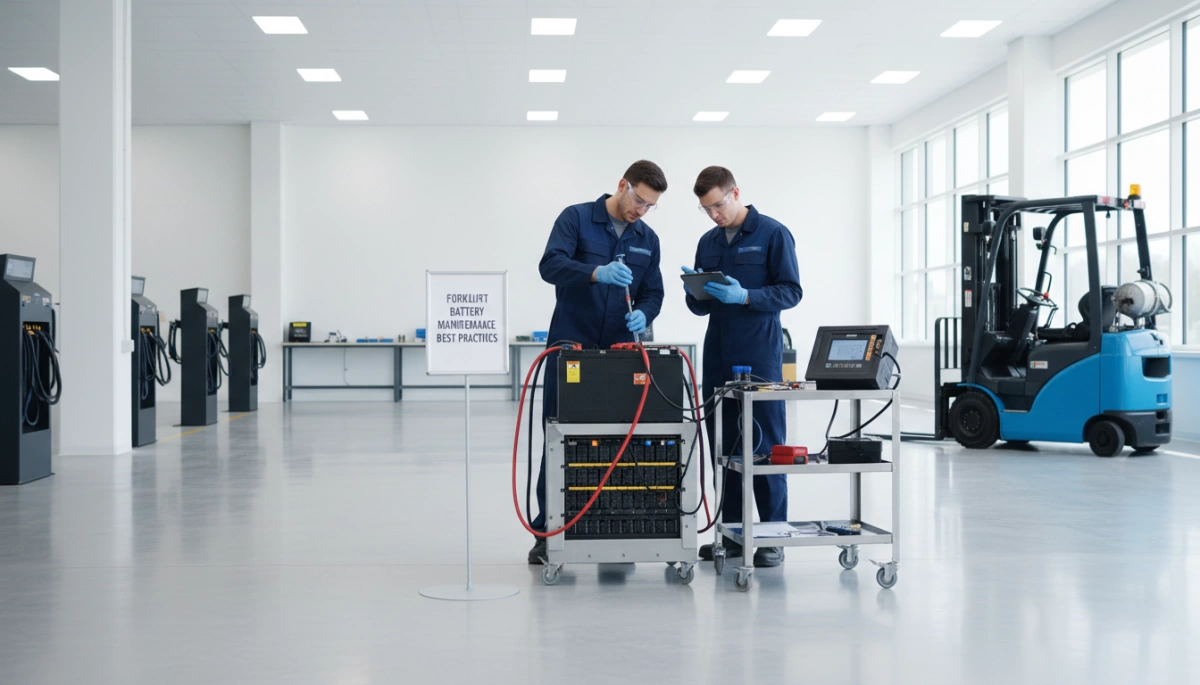
Ideal charge and discharge range for lead-acid forklift batteries
For lead-acid forklift battery care, I always recommend a simple rule:
- Discharge only to 20–30% State of Charge (SOC) (70–80% depth of discharge max)
- Recharge back to 100% in one full cycle
Running batteries below 20% on a regular basis kills capacity fast and makes forklift lead-acid battery runtime drop off a cliff. Charge when: - The battery indicator hits the “red” or 20–30% zone
- The shift ends and the truck is going out of service
This alone can easily extend forklift battery lifespan by months or even years.
Avoiding opportunity charging mistakes
Opportunity charging can help in busy warehouses, but only when done right:
- Don’t “sip charge” every break – limit charges to planned windows (e.g., lunch, shift change)
- Always charge long enough to move the needle (at least 30–60 minutes)
- Never interrupt charging constantly, it creates shallow cycles and sulfation
- Use chargers specifically designed for opportunity charging or fast charging
If you’re unsure which pattern suits your fleet, check the charger manual and our latest industrial battery maintenance tips in the battery knowledge blog section.
Setting proper cool-down time after charging
Forklift battery temperature monitoring is non‑negotiable: hot batteries age faster. Best practice:
- Cool down 8–10 hours after a full charge before heavy use
- If the case feels hot to the touch, let it sit longer
- Avoid back‑to‑back charge–discharge cycles with no rest
This cool‑down window helps cut water loss, reduces plate damage, and supports deep cycle industrial battery care.
Rules for idle or stored forklift batteries
If a truck or battery is sitting:
- Fully charge before storage
- Top up with a fresh charge every 30 days (or follow the manufacturer’s forklift battery maintenance schedule)
- Store in a cool, dry, ventilated area away from heat sources
- Disconnect from the truck and charger to avoid parasitic drain
For long idle periods, these simple rules prevent forklift battery sulfation and keep runtime stable when you put the battery back to work.
Using smart chargers and manufacturer settings
Modern smart chargers make forklift battery charging best practices much easier:
- Set charger voltage and AH rating to match the battery label exactly
- Enable automatic equalization charge according to the forklift battery equalization schedule
- Use built‑in temperature compensation if available
- Never mix batteries and chargers across different chemistries or capacities
When we deploy batteries for customers, we always pair them with the right battery charger settings for forklifts and document them in a simple battery log sheet so operators don’t have to guess. For more technical setup guidance or custom charger configurations, you can reach us directly through our contact and support page.
Watering and Electrolyte Management
Getting watering and electrolyte management right is the fastest way to extend forklift battery lifespan and avoid surprise failures. Lead-acid forklift battery care lives or dies on this step.
How often to water a lead‑acid forklift battery
For most lead‑acid industrial batteries, a safe rule:
- Water 1–2 times per week in normal, single-shift use
- 2–3 times per week in heavy, multi-shift or high-temperature warehouses
- Always water after a full charge, never before charging
Set a clear forklift battery watering schedule and log each watering on a simple battery log sheet for forklifts so nothing gets missed.
Correct water level in each cell
Every cell has plastic “spillover” or level indicators. Basic rules:
- Before charging: Plates can be slightly exposed (ok if not dry)
- After charging and cooling:
- Water should sit just below the vent well / level ring
- Plates must be fully covered, but no standing water in the vent neck
- Never fill “to the top” – that’s a guaranteed overflow once the battery warms up
Train operators to look straight down into each cell and check levels as part of your forklift battery daily checklist.
Distilled or deionized water only
Use distilled or deionized water for batteries. Tap water brings in minerals and contaminants that cause:
- Faster forklift battery sulfation
- Higher self‑discharge
- Extra corrosion on terminals and intercell connectors
For new or replacement batteries, I always match them with a proper watering routine and, when needed, recommend our industrial batteries from our electric forklift battery range that are designed for easier watering and longer service life.
Overwatering vs. underwatering
You can spot mistakes quickly if you know what to look for:
Overwatering looks like:
- Wet battery top and case after charge
- Acid residue around vent caps and battery tray
- White or blue‑green corrosion on terminals and cables
- Higher maintenance needs and shortened runtime
Underwatering looks like:
- Exposed or discolored plates when you open vent caps
- Strong sulfur smell during use or charge
- Cells running hotter than others
- Permanent capacity loss and poor forklift lead‑acid battery runtime
If plates have been exposed for a while, that damage is usually permanent.
Forklift battery sulfation prevention
Proper watering is one of the best forklift battery sulfation prevention tools you’ve got:
- Keep plates covered at all times
- Follow a consistent watering schedule after charging
- Avoid deep discharge below 80% depth of discharge
- Make sure charger settings match your deep cycle industrial battery type
Combine correct watering, proper battery charger settings for forklifts, and regular inspection, and you’ll easily add 1–3 years of life to most lead‑acid forklift batteries in a busy warehouse.
Cleaning and Corrosion Control
Keeping your forklift batteries clean isn’t cosmetic – it’s how you protect runtime, safety, and lifespan. Here’s the exact forklift battery cleaning procedure and schedule we follow in our own operations.
Safe Cleaning Routine for Forklift Battery Tops and Cases
I treat every battery like a live power source, not a dirty box:
- Shut down and disconnect
- Turn the truck OFF and unplug the charger.
- Use proper PPE: goggles/face shield, acid-resistant gloves, apron.
- Dry clean first
- Blow or wipe off dust and debris from the battery top and tray.
- Remove metal tools, straps, or loose hardware from the top.
- Neutralize and wash
- Use a baking soda + water mix or a commercial battery neutralizer spray.
- Lightly spray or wipe the battery top and case – do not flood the cells.
- Avoid getting solution into vent caps or inside cells.
- Rinse and dry
- Wipe with a damp cloth, then dry with clean rags.
- Keep vent caps snug and upright the whole time.
This kind of basic lead-acid forklift battery care keeps acid residue from building up and causing problems.
Products and Tools to Prevent Forklift Battery Corrosion
For industrial battery maintenance, I stick to a simple, reliable kit:
- Non‑metallic brush (nylon) for cleaning terminals and connectors
- Battery neutralizer spray or baking soda solution
- Corrosion‑resistant terminal spray/gel (after cleaning and drying)
- Lint‑free rags and disposable wipes
- Plastic scrapers, never metal, to avoid shorts
- Dedicated tools for the battery room only – no mixed workshop tools
Use these regularly and you’ll prevent forklift battery corrosion instead of fighting it when it’s already severe.
How Corrosion Hits Performance and Safety
Corrosion isn’t just ugly; it costs you money and risk:
- Higher resistance = shorter runtime
- Corroded terminals and connectors drop voltage and reduce forklift lead-acid battery runtime.
- Heat and damage
- High resistance points heat up, which accelerates forklift battery sulfation and cable damage.
- Shock and fire hazards
- Wet, acid-covered tops can cause tracking (current running across the surface), leading to:
- Arcing
- Blown fuses
- Risk of shock or fire
- Wet, acid-covered tops can cause tracking (current running across the surface), leading to:
- Faster battery failure
- Ignored corrosion often ends in early battery replacement and higher total cost.
In short, a dirty, corroded battery is an unsafe and expensive battery.
Simple Schedule to Keep Terminals, Cables, and Connectors Clean
I build cleaning into our forklift battery maintenance schedule so it actually happens:
- Daily (quick check – operator level)
- Visual check for wet spots, powdery buildup, or loose cables.
- Note issues in the battery log sheet for forklifts.
- Weekly (light clean)
- Wipe tops and trays after watering and charging.
- Check connectors and cables for early corrosion or damage.
- Monthly (deeper clean)
- Neutralize and clean terminals, connectors, and tray thoroughly.
- Apply light corrosion protectant to terminals once fully dry.
- Quarterly (full inspection clean)
- Combine with a full forklift battery inspection checklist:
- Terminals, cables, connectors
- Case, tray, vent caps
- Tag any batteries that need repair or technician attention.
- Combine with a full forklift battery inspection checklist:
With this simple routine, you keep terminals, cables, and connectors clean, protect your deep cycle industrial batteries, and quietly extend forklift battery lifespan without needing fancy gear.
Forklift Battery Inspection Checklist
A solid forklift battery inspection checklist keeps failures and surprise downtime off your floor. Here’s how I have operators run simple, fast checks that actually catch problems early.
Step-by-Step Inspection Process for Operators
I train drivers to follow this same basic sequence every time:
- Before startup
- Do a quick walk-around of the truck and battery compartment.
- Confirm the battery is seated correctly and locked in.
- Visual battery check
- Inspect the case, tray, cables, and connectors before turning the key.
- After the shift
- Check for leaks, heat, or damage after use.
- Log any issues on the forklift battery daily checklist or battery log sheet.
This takes 1–3 minutes and pays off in longer lead-acid forklift battery life and better uptime.
What to Look For: Case, Vent Caps, and Trays
When I build an industrial battery maintenance checklist, I keep it simple and visual:
- Battery case
- Look for cracks, bulges, dents, or splits.
- Check for damp or shiny areas that might mean acid leaks.
- Vent caps
- Make sure all battery vent caps are present and tight.
- Look for crusty white/green buildup around caps (sign of overfill or leaks).
- Battery tray and compartment
- Check for pooled liquid or rust in the tray.
- Confirm hold-downs and brackets are secure.
- Make sure no tools, bolts, or metal objects are sitting on the battery.
Anything off here is a red flag for forklift battery safety and must be logged.
Early Signs of Damage or Failure
I tell teams to call these out immediately:
- Unusual heat
- Battery hotter than normal after use or charging.
- Corrosion and buildup
- White/blue/green powder on terminals, cables, or tray.
- Smell or fumes
- Strong sulfur/rotten-egg smell near the battery room.
- Runtime and charging changes
- Truck doesn’t make it through normal shift.
- Charger takes much longer or ends much faster than usual.
- Physical damage
- Swelling sides, cracked cables, melted connectors, loose lugs.
These are classic forklift battery troubleshooting triggers. If operators spot them early, we prevent bigger failures and extend forklift lead-acid battery runtime.
Checklist Template Ideas (Daily / Weekly / Monthly)
Here’s how I usually structure a simple forklift battery inspection checklist for a global warehouse team:
Daily (Operator – quick checks)
- [ ] Battery secured in tray
- [ ] No cracks, bulges, or leaks on case
- [ ] All vent caps present and tight
- [ ] No loose or exposed cables
- [ ] No tools/metal on battery top
- [ ] No strong odor, smoke, or unusual heat
- [ ] Runtime and power feel normal
Weekly (Supervisor / tech – deeper visual check)
- [ ] Cables, lugs, and connectors free of heavy corrosion
- [ ] Tray and compartment clean and dry
- [ ] Labels and safety decals readable
- [ ] Charger cables, plugs, and leads in good condition
Monthly (Maintenance – structured inspection)
- [ ] Detailed case and tray inspection for rust or acid damage
- [ ] Check all connectors for wear, cracks, or overheating marks
- [ ] Review battery log sheet for forklifts for repeated issues
- [ ] Schedule equalization and forklift battery temperature monitoring if needed
Build this into your forklift battery maintenance schedule, post it in the battery room, and make it part of driver training. When operators own this checklist, your electric forklift battery maintenance gets consistent, and your fleet runs longer with fewer surprises.
Common Forklift Battery Mistakes to Avoid
When I walk into a warehouse, I can usually tell in five minutes if their forklift battery maintenance is under control. The same problems show up over and over. Here’s what I avoid in my own operations.
Bad Charging Habits
Bad charging is the fastest way to kill a lead‑acid forklift battery.
- Running batteries below 20% charge on a regular basis
- “Opportunity charging” all day with the wrong settings
- Stopping charges early and never letting the charger finish
- Charging hot batteries right after a hard shift
Stick to a clear forklift battery charging best practices policy: full cycles, proper cool‑down, and correct battery charger settings for forklifts.
Ignoring Watering and Electrolyte Levels
If your forklift battery watering schedule is “when someone remembers,” you’re already losing runtime.
- Not checking forklift battery electrolyte levels after charging
- Letting plates get exposed (underwatering)
- Filling before charge and causing overflow (overwatering)
Use only distilled or deionized water for batteries and log every top‑up. Consistent watering is key for forklift battery sulfation prevention.
Skipping Safety and PPE
This one is non‑negotiable.
- No PPE (gloves, goggles, apron) in the battery room
- Ignoring OSHA forklift battery safety rules
- Handling cables and connectors with bare hands
Proper forklift battery safety precautions protect your team and keep you compliant.
Letting Dirt, Acid, and Corrosion Build Up
A dirty battery is a problem waiting to happen.
- Acid residue on the case
- Corrosion on terminals and connectors
- Battery tops covered in dust, shrink wrap, or debris
Follow a simple forklift battery cleaning procedure and prevent forklift battery corrosion with regular neutralizing and wiping. Clean batteries run cooler and last longer.
Using the Wrong Charger or Settings
I see this mistake globally in mixed fleets.
- Wrong charger voltage or amp rating
- Ignoring manufacturer battery equalization charge settings
- Using a generic charger on a specialized electric forklift battery
Match every battery to the right charger, set the proper forklift battery equalization schedule, and standardize settings across sites. It’s one of the easiest ways to extend forklift battery lifespan and protect your investment.
Troubleshooting Forklift Battery Problems
When I look at forklift battery problems, I don’t guess—I follow a simple, repeatable checklist. That’s how I protect runtime, trucks, and people.
Warning signs of a failing forklift battery
Here’s what tells me a lead-acid forklift battery is on its way out:
- Shorter runtime vs. normal, even after a full charge
- Truck feels weak on lifts or travel, voltage drops under load
- Charger runs longer than usual or restarts often
- Cells show low specific gravity on a hydrometer test
- Visible issues: cracked case, bulged sides, heavy corrosion, burned connectors
- Strong sulfur smell (rotten egg) during or after charging
Any of these signs mean the battery needs proper forklift battery troubleshooting, not just another charge.
What to do if runtime drops or charging takes too long
If forklift lead-acid battery runtime falls off, I work through this quickly:
-
Check basics first
- Confirm correct battery charger settings for forklifts (voltage, Ah, profile)
- Make sure the charger matches the battery (no mismatched chargers)
- Inspect connectors for heat, pitting, or loose pins
-
Verify watering and electrolyte
- Check forklift battery electrolyte levels after charge
- Top up with deionized water for batteries if below proper level
- Look for dry or discolored plates (sign of damage or sulfation)
-
Test battery health
- Use a hydrometer test for forklift batteries to compare cell readings
- Log results on a battery log sheet for forklifts to track trends
- If variation between cells is high, schedule a battery equalization charge or professional test
If the charger takes too long or never reaches full, I stop using the battery until I confirm it’s safe and the charger is functioning correctly.
Handling overheating, swelling, or leaking batteries
Overheating or swelling isn’t “normal wear”—it’s a stop-now issue:
-
If the battery is hot to the touch during charge or operation:
- Stop charging and disconnect safely
- Check ambient temperature and forklift battery temperature monitoring data if you use sensors
- Avoid using that battery until it’s inspected
-
If the case is swelling or bulging:
- Remove the forklift from service
- Tag the battery “Do Not Use”
- Call a forklift battery technician or industrial battery service provider
-
If you see leaking acid:
- Clear the area and follow your OSHA forklift battery safety rules
- Neutralize spills according to your forklift battery cleaning procedure
- Wear full PPE and don’t let operators touch that battery
Overheating, swelling, or leaks can indicate internal damage, gas buildup, or serious faults—none of these belong in active service.
When to remove a forklift battery from service immediately
I don’t take chances with batteries that show any of these:
- Cracked or severely swollen case
- Active acid leak or heavy, fresh corrosion around posts or trays
- Melted, burned, or loose connectors and cables
- Repeated overheating during charging or use
- Strong, constant sulfur smell and gassing
- Cells with zero or very low specific gravity compared to others
In these cases, I:
- Tag the unit “Out of Service”
- Remove it from the rotation according to proper forklift battery handling rules
- Call in a qualified forklift battery technician or service partner
- Log everything for traceability in the forklift battery maintenance schedule
This disciplined approach to forklift battery troubleshooting helps extend forklift battery lifespan, protects uptime, and keeps operators safe.
Building a Forklift Battery Maintenance Schedule
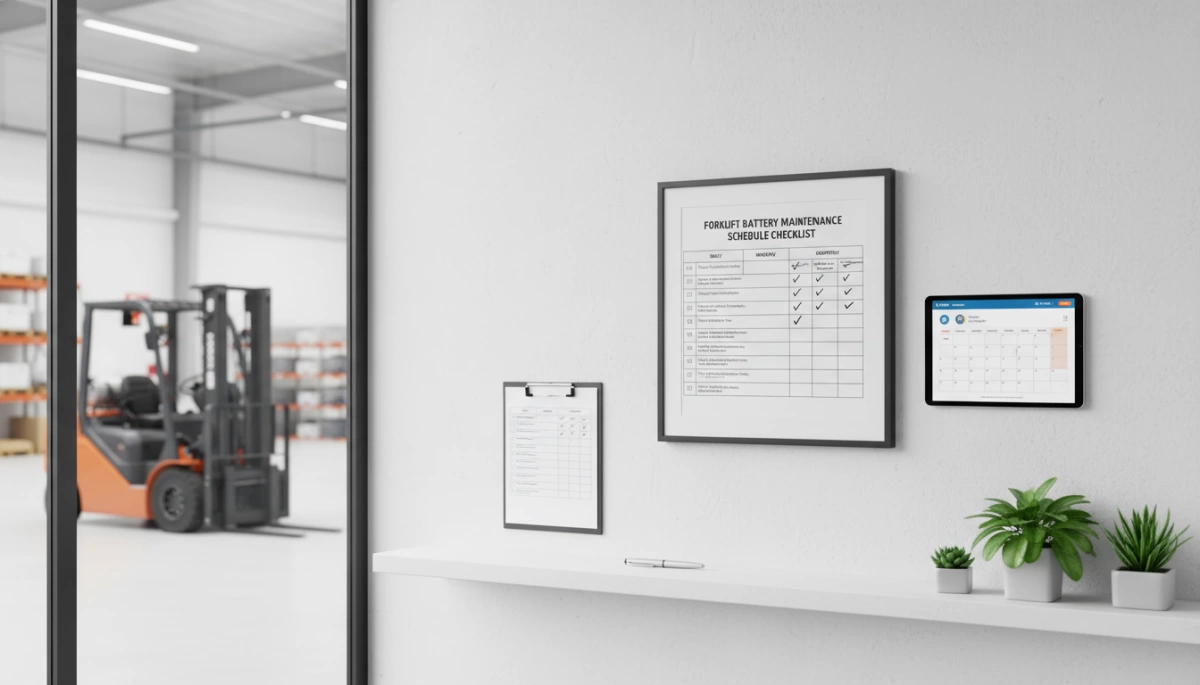
A solid forklift battery maintenance schedule is what actually turns “good intentions” into longer battery life, fewer breakdowns, and predictable costs. I treat it like any other core process in the warehouse: clear checklists, clear owners, and simple tools to track it.
Daily, Weekly, Monthly Checklist for Your Fleet
Start by breaking your forklift battery maintenance checklist into simple routines:
Daily – operator level (before / after shift)
- Quick visual check: damage, leaks, corrosion, loose cables
- Confirm forklift battery charge level and no deep discharges
- Make sure the battery is secured in the truck, no metal tools on top
- Log runtime issues or alarms in a battery log sheet for forklifts
Weekly – technician or lead operator
- Check forklift battery electrolyte levels after charging
- Top up with distilled or deionized water for batteries as needed
- Wipe tops clean to prevent forklift battery corrosion
- Spot-check temperatures and cable condition
Monthly – maintenance team
- Full forklift battery inspection checklist: cases, vent caps, trays
- Review charge cycles, equalization history, and runtime trends
- Adjust forklift battery watering schedule and charging habits if needed
- Plan battery equalization charge for lead-acid units per the OEM / fleet policy
Keep it on one page per truck/battery so anyone can read it fast.
Assign Responsibilities Clearly
If everyone owns it, nobody owns it. I split proper forklift battery handling like this:
-
Drivers / operators
- Follow the forklift battery daily checklist
- Report low runtime, slow charging, or overheating
- Park at the right charger with the right settings
-
Maintenance staff / supervisors
- Manage weekly/monthly checks and electric forklift battery maintenance
- Set and verify forklift battery charging best practices
- Handle equalization, repairs, and safety compliance
- Train operators on OSHA forklift battery safety rules
Post a simple responsibility chart in the battery room so there’s no confusion.
Use Logs, Tags, and Simple Tools
You don’t need fancy software to keep industrial battery maintenance under control, but you do need proof and traceability:
- Battery log sheet for forklifts
- Date, operator, start/end SOC, water added, issues found
- Color-coded tags / stickers
- “Needs service”, “Do not use”, “Equalization due”, “New battery”
- Wall charts or digital tracker
- Forklift battery equalization schedule
- Last hydrometer test for forklift batteries
- Last cleaning / watering date
This helps you catch trends early: recurring low runtime, hot batteries, or constant watering can signal forklift battery sulfation or charger issues.
Adapt to Battery Types and Workloads
Not every fleet runs the same way, so I always tune the forklift battery maintenance schedule to:
- Battery type
- Flooded lead-acid: tighter focus on watering, vent cap inspection, battery equalization charge, cleaning
- Sealed/maintenance-free: more focus on forklift battery temperature monitoring, charging patterns, and runtime
- Workload & shifts
- Heavy multi-shift use: stricter forklift battery charging best practices, more frequent inspections
- Light or seasonal use: include “how to store forklift batteries” (charged, cool, dry, periodic top-up charges)
The goal is simple: consistent, repeatable warehouse forklift battery care that fits your actual operation. When the schedule is clear, tracked, and tailored, you extend forklift battery lifespan, cut downtime, and keep the floor running.
Benefits of Consistent Forklift Battery Maintenance
When I stick to a clear forklift battery maintenance checklist, everything in the operation runs smoother, cheaper, and safer. Here’s what consistent care really delivers.
Extend Forklift Battery Lifespan
Regular lead-acid forklift battery care (watering, cleaning, correct charging) can easily add 1–3 extra years of life.
| Action | Benefit |
|---|---|
| Proper forklift battery watering schedule | Prevents sulfation and dry plates |
| Routine cleaning & corrosion control | Protects cases, trays, and terminals |
| Correct battery equalization charge | Balances cells and restores capacity |
Fewer battery replacements = less capital tied up and less disruption.
Improve Uptime & Warehouse Productivity
A well-maintained battery delivers full runtime and predictable performance.
- Less mid‑shift charging and battery swaps
- Fewer breakdown calls and unplanned stoppages
- More reliable electric forklift battery maintenance across the fleet
That stability is what keeps pallets moving and service levels high.
Lower Total Cost of Ownership
Good industrial battery maintenance directly lowers operating cost:
- Longer life = lower annual battery spend
- Efficient charging = lower energy bills
- Less damage to chargers, connectors, and trucks
With a tight forklift battery maintenance schedule and a simple battery log sheet for forklifts, I keep the true cost per operating hour down.
Boost Safety & Compliance
Consistent checks and proper forklift battery safety precautions protect people and assets:
- Reduced risk of acid spills, fires, and electrical shorts
- Better forklift battery temperature monitoring and gas ventilation
- Easier compliance with OSHA forklift battery safety rules and local standards
In global warehouses where labor, space, and time are all tight, disciplined warehouse forklift battery care is one of the fastest ways to protect margins and keep crews safe.
Forklift Battery Watering System: Manual vs Automatic Guide
Forklift Battery Runtime Calculator: Capacity & Working Hours Guide