Warehouse Battery Charging Optimization for Multi Shift Operations

If your facility runs multi-shift forklift operations, you already know one thing: your warehouse battery charging strategy can either keep your fleet moving nonstop… or quietly drain your uptime and profits.
Most warehouses still struggle with the same issues:
- Forklifts sitting idle during peak hours
- Rushed, incomplete charges between shifts
- Shortened battery lifespan from improper charging
- Rising energy costs and complex swap routines
The good news? With the right warehouse battery charging optimization plan, you can turn your charging system into a real competitive edge—cutting downtime, extending battery life, and lowering total costs, especially in 2–3 shift or 24/7 operations.
In this guide, you’ll see how to:
- Choose the right charging method for multi-shift operations (conventional, opportunity, fast charging)
- Leverage lithium-ion forklift batteries and smart chargers to eliminate unnecessary swaps
- Use data and a battery management system to maximize uptime with minimal disruption
And you’ll also learn how XICHA Battery helps high-demand warehouses implement these strategies in the real world—safely, efficiently, and with clear ROI.
Let’s get straight into how to keep your forklifts ready every minute of every shift.
Understanding Warehouse Battery Charging Optimization for Multi-Shift Operations
If your forklifts run beyond a single day shift, warehouse battery charging optimization is no longer optional—it’s core to keeping product moving and costs under control. When I talk about Warehouse Battery Charging Optimization for Multi-Shift Operations, I mean building a charging strategy that is intentional, data-driven, and aligned with your actual shift patterns and workloads, not just plugging in batteries “when they’re low.”
What Battery Charging Optimization Really Means
In practical terms, warehouse battery charging optimization is about:
- Right timing: Charging at the right depth of discharge, at the right time in the shift, not “whenever there’s a plug free.”
- Right method: Choosing between conventional, opportunity, or fast charging based on your fleet and shifts.
- Right infrastructure: Using the correct chargers, power capacity, and layout to support 2–3 shifts or 24/7 operations.
- Right controls: Using smart battery chargers and (ideally) a battery management system to monitor, enforce, and improve charging habits.
The result: less downtime, longer battery life, safer charging areas, and lower total cost of ownership (TCO).
How Multi-Shift Operations Change Your Battery Strategy
Multi-shift forklift operations break the old “charge everything overnight” model. As soon as you move to 2–3 shifts or 24/7 warehouse operations, your strategy must change:
- No long idle window: You lose the 8–10 hour block needed for traditional overnight charging of lead-acid forklift batteries.
- Higher utilization: Batteries routinely run deeper into their capacity, increasing the risk of damaging deep discharges.
- More touch points: More shifts mean more operators, more handovers, and more chances for inconsistent charging behaviors.
- Different charging windows: Charging now has to fit into breaks, shift changes, and planned downtimes—not just midnight to 6 a.m.
In this environment, opportunity charging for warehouses, fast charging industrial batteries, or switching to lithium-ion forklift batteries can become far more efficient than old-school full-cycle charging.
Key Goals: Uptime, Safety, Cost, Battery Life
Any multi-shift warehouse battery strategy must be built around four non-negotiables:
-
Uptime:
- Forklifts must be ready when needed.
- Goal: Near-zero equipment sitting idle waiting for charged batteries.
-
Safety:
- Charging stations, cables, and battery handling must be low risk.
- Goal: No trips, no crush points, no uncontrolled off-gassing or hot batteries.
-
Cost Control:
- Energy, labor, and equipment must be optimized.
- Goal: Lower warehouse energy management costs and reduced labor wasted on battery swapping and hunting for charged units.
-
Battery Life:
- Fewer premature battery replacements.
- Goal: Maximize cycles and protect warranty by avoiding over-discharge, overcharging, and unnecessary equalization charging.
When these goals are balanced, you get forklift battery downtime reduction and a cleaner, more predictable cost per operating hour.
Common Charging Mistakes in Warehouses
Most operations leak money and uptime through avoidable charging habits. The most common issues I see:
-
Running lead-acid forklift batteries too deep
Regularly going below recommended depth of discharge accelerates sulfation and shortens life. -
Random, unplanned charging
Operators plug in “whenever” or “wherever,” creating:- Peak demand spikes and higher utility bills
- Inconsistent state of charge at the start of shifts
- Bottlenecks around a few popular chargers
-
Ignoring charger and battery compatibility
Using the wrong charger profile or settings for specific lead-acid vs lithium battery charging reduces performance and voids warranties. -
No clear charging rules or accountability
Without simple rules and training, opportunity charging best practices are never followed, and batteries are abused. -
Zero data, zero visibility
No battery management system warehouse tools, no tracking of charge cycles, temperatures, or failures—so decisions are made on guesswork instead of real data.
Fixing these basics is the fastest way to unlock warehouse battery charging optimization and see immediate gains in uptime, safety, and TCO.
Multi-Shift Warehouse Pain Points
Running 2–3 shifts changes everything about warehouse battery charging optimization. In a multi-shift forklift fleet, the weak link is rarely the truck – it’s almost always the charging plan.
Limited Charging Windows Between Shifts
With back-to-back shifts, there’s almost no “overnight” window left. Batteries come off one truck and are expected to be ready for the next shift in a couple of hours or less. If your chargers aren’t sized or scheduled for multi-shift forklift operations, you end up:
- Starting shifts with half-charged batteries
- Pushing batteries deeper into discharge than they’re designed for
- Burning through battery life years earlier than you should
Frequent Battery Swapping and Handling Delays
Constant battery swapping sounds efficient, but it quietly kills productivity and adds cost:
- Time lost driving to the battery room, changing batteries, and logging swaps
- Extra labor to manage heavy battery handling equipment
- Higher risk of damage to connectors and cables from frequent plugging/unplugging
A smarter setup with the right forklift batteries and chargers can cut swap frequency and keep trucks on the floor.
Trucks Sitting Idle Waiting for Charged Batteries
Nothing hurts throughput like forklifts parked because there’s no charged battery ready:
- Orders back up because a few key trucks are down
- Supervisors start “stealing” batteries between trucks just to keep things moving
- Operators lose trust in the equipment and create their own charging habits
This is where real warehouse battery charging optimization directly drives forklift battery downtime reduction.
Heat, Sulfation, and Short Battery Life
In heavy multi-shift use, lead-acid batteries rarely get the slow, full charge and cool-down they need:
- Frequent partial charges drive sulfation and capacity loss
- Fast turnarounds trap heat in batteries and chargers
- Over the months, runtime drops, and you need more frequent replacements
Without tight control on charge rates, ventilation, and equalization, you pay for it in shortened battery lifespan.
Rising Energy Bills from Unplanned Charging
When operators plug in “whenever they can,” chargers often run at the worst possible times:
- Charging during utility peak hours drives up demand charges
- Uncoordinated fast charging creates big, short spikes in power use
- No one has a clean kWh-per-hour-run or kWh-per-pallet-moved number
Using smart battery chargers for forklifts and simple rules by shift can turn this chaos into predictable warehouse energy management.
Safety Risks Around Charging and Swap Areas
High-throughput charging zones are one of the riskiest spots in a multi-shift warehouse:
- Trip hazards from loose cables in tight aisles
- Battery acid exposure, off-gassing, and hot surfaces in cramped rooms
- Congestion as multiple trucks compete for the same chargers
A clean warehouse charging station layout with clear walkways, proper ventilation, and well-placed battery chargers is not optional – it’s core to safe, high-uptime multi-shift operations.
How Multi-Shift Patterns Impact Charging Strategy
Single-Shift vs Multi-Shift Warehouses
In warehouse battery charging optimization, the number of shifts completely changes the game.
| Operation Type | Typical Charging Window | Battery Strategy |
|---|---|---|
| Single-shift (8 hrs) | 8–12 hrs overnight | Classic full charge, slow/conventional |
| 2-shift (16 hrs) | 3–6 hrs split in the day | Mix of full charge + opportunity charging |
| 3-shift / 24/7 | 0–2 hrs scattered breaks | Fast or intensive opportunity charging; often lithium |
In single-shift sites, almost any forklift battery charging schedule will “work.” In 2–3 shift or 24/7 sites, you need a multi-shift warehouse battery strategy or you’ll run out of energy mid-shift.
What 24/7 Operations Do to Battery Cycles
In multi-shift forklift operations, batteries are pushed to the limit:
- More cycles per year → batteries hit end-of-life faster.
- Less rest time → higher temperature, more stress on cells.
- More partial charges → if unmanaged, can cause uneven aging.
With 24/7 operations, each battery becomes a critical asset, not a consumable. For high-voltage fleets (for example, 80V forklift batteries in heavy-duty applications), I typically specify chargers that can reliably recover usable charge in short breaks, not just overnight. You can see the kind of pack I’m talking about in our 80V forklift battery range.
Depth of Discharge (DoD) in High-Utilization Fleets
Managing depth of discharge is key to forklift battery lifecycle management:
- Lead-acid forklift batteries
- Best kept at 20–80% state of charge (SoC).
- Regularly going below 20–30% SoC kills cycle life fast.
- Lithium-ion forklift batteries
- Can safely run deeper, but constant 0–5% SoC still hurts life.
Aim to avoid “run it until it dies.” In optimized fleets, I set rules like: “Plug in below 40% SoC anytime you stop for 15+ minutes.”
Why “Overnight Charging” Doesn’t Work Anymore
For 24/7 warehouse operations charging, “park and charge overnight” is outdated:
- There is no true off-shift to recover all batteries.
- A single bad charging decision can impact next-shift uptime.
- Unplanned plug-ins cause random peak loads and higher energy bills.
Modern warehouse battery charging optimization relies on:
- Opportunity charging for warehouses during breaks and shift handovers.
- Fast charging industrial batteries in planned windows.
- Smart battery chargers for forklifts that adapt to shift patterns and avoid over-stressing packs.
Once you add that second or third shift, charging becomes an operational design problem, not a “plug it in and forget it” task.
Forklift Battery Types in Multi-Shift Operations
Lead-acid forklift batteries in multi-shift use
Lead-acid forklift batteries can work in multi-shift operations, but they demand discipline. They need:
- 6–8 hours of full charging
- 6–8 hours of cooldown
- Regular watering and equalization
If you’re running 2–3 shifts with lead-acid, you usually need spare batteries, a battery room, and time for swaps. If operators ignore charge levels or run batteries too deep, you’ll see sulfation, heat issues, and a much shorter battery life.
Lithium-ion forklift batteries in high-uptime warehouses
Lithium-ion forklift batteries are built for high-uptime, multi-shift warehouses. They charge faster, don’t need cooldown, and handle frequent top-ups without damage. There’s no watering, no gassing, and no equalization. In many sites, one lithium pack can replace a two- or three-battery lead-acid setup, especially for electric stackers or pallet jacks using dedicated lithium forklift batteries.
How battery chemistry affects charging options and schedules
Battery chemistry defines what charging strategy you can safely use:
- Lead-acid: Prefers full charge cycles; best with conventional or controlled opportunity charging. Needs planned off-shift charging and strict depth-of-discharge limits (typically 80% DoD max).
- Lithium-ion: Works perfectly with opportunity charging and even fast charging. You can plug in during breaks, shift handovers, or lunch without hurting battery life.
Lead-acid vs lithium battery charging in real warehouse scenarios
In real multi-shift warehouse operations:
- A lead-acid fleet often runs:
- Multiple batteries per truck
- Dedicated swap room, battery changers, and extra labor
- Night-time conventional charging plus weekly equalization
- A lithium-ion fleet typically runs:
- One battery per truck
- Chargers placed close to work areas
- Short, frequent opportunity charges to keep state of charge high
If you’re constantly short on charged batteries, juggling swap schedules, or losing time walking trucks to a remote battery room, switching to a lithium-centric warehouse battery charging optimization strategy usually delivers faster uptime gains and cleaner multi-shift forklift operations.
Core Charging Methods for Warehouse Fleets
When I look at warehouse battery charging optimization, I always start with the charging method. Your choice here decides uptime, labor cost, and battery life more than almost anything else.
Conventional Charging for Forklifts
Conventional charging is the classic “full shift, then full charge” model. Trucks run a shift, batteries discharge to 70–80% depth of discharge, then charge for 8–10 hours.
Where it fits:
- Low to medium‑duty fleets
- 1–2 shifts with long overnight windows
- Operations comfortable with battery swaps and extra spare batteries
If you’re running lead‑acid, a well‑matched set of lead-acid forklift battery chargers keeps the process predictable and safe.
Opportunity Charging for Short Breaks
Opportunity charging uses every small pause—breaks, lunch, loading queues—to top up batteries. Instead of one deep cycle per day, you run multiple mini‑cycles.
Best for multi-shift warehouse battery strategies when:
- Drivers have frequent 10–30 minute breaks
- You want to avoid battery swaps
- You need forklift battery downtime reduction without adding more trucks
Done right, opportunity charging keeps state of charge between ~30–80%, which is ideal for many lithium-ion forklift batteries and can also work for properly managed lead‑acid.
Fast Charging for High-Demand Sites
Fast charging industrial batteries pushes high current into the battery to recover charge in 1–2 hours or less.
When it makes sense:
- 24/7 warehouse operations charging
- High-utilization fleets that can’t spare trucks for long
- Sites willing to invest in robust power infrastructure and cooling
You need the right battery chemistry, charger profile, and clear rules so operators don’t fast charge on already hot or over-discharged batteries.
Battery Equalization Charging
Equalization charging is an intentional overcharge on lead‑acid to rebalance cells and reduce sulfation.
Use it carefully:
- Typically once per week (or as recommended)
- Only on compatible lead‑acid forklift batteries
- Never as a band‑aid for poor charging habits
It helps restore some lost capacity, but too much equalization shortens battery life and burns extra energy.
How Smart Battery Chargers Change Multi-Shift Operations
Smart battery chargers and modern battery management systems are game‑changers for multi-shift forklift operations. They can:
- Auto-select the right profile for lead‑acid vs lithium-ion
- Log charge events, temperature, and faults
- Limit charging during peak tariff periods
- Enforce proper charge cutoffs and equalization intervals
With intelligent lithium forklift battery chargers, I can align the charging schedule with your actual shift pattern, cut energy waste, and extend overall battery lifecycle—without asking operators to become battery experts.
Choosing the Right Charging Method for Your Shifts
Picking the right charging approach is the core of warehouse battery charging optimization for multi-shift operations. The goal is simple: keep trucks moving, protect battery life, and avoid wasting labor and energy.
Matching Charging Strategy to 2‑Shift vs 3‑Shift Patterns
For 2‑shift warehouses (16 hours/day):
- Lead-acid:
- Conventional overnight charging usually still works.
- Add light opportunity charging during breaks if trucks regularly hit low state of charge before the end of the second shift.
- Lithium-ion:
- Short top-ups during breaks easily cover two shifts.
- You can often run one battery per truck with no swaps.
For 3‑shift / 24/7 operations:
- Lead-acid:
- You typically need battery pools and swap systems, or high-power fast chargers + strict rules.
- Equalization and cooldown become harder to schedule.
- Lithium-ion:
- Opportunity and fast charging during breaks, shift handovers, and lunch can fully support 24/7 with no swaps.
- This is where lithium really shines in multi-shift forklift operations.
Charge Time vs Downtime: What Really Matters
I don’t optimize for “shortest charge time” alone—I optimize for least total downtime:
- Conventional charging: Long charge, long downtime, but simple process.
- Opportunity charging for warehouses: Short, frequent charges during natural pauses keep trucks productive.
- Fast charging industrial batteries: Higher power, less charge time, but you must watch heat, power demand, and charger cost.
The right mix depends on:
- How often trucks stop naturally (breaks, driver changeovers).
- How far batteries are being discharged each shift.
- Whether you have room and labor for swap rooms, or need a battery swap room alternative like on-truck charging.
Impact on Battery Life and Warranty
Each method hits battery life and warranty differently:
- Lead-acid conventional
- Best battery longevity if you stick to full cycles and proper equalization.
- But deep discharges in 24/7 use can still kill life quickly.
- Lead-acid opportunity charging
- Works well if you manage depth of discharge and follow OEM rules.
- Too many partial charges or frequent deep discharges can void warranties.
- Lead-acid fast charging
- Often needs chargers and batteries specifically rated for fast charge.
- Extra heat and stress can shorten life if mismanaged.
- Lithium-ion forklift batteries
- Built for partial charges and high-utilization fleets.
- Almost always paired with smart battery chargers, strong BMS, and clear warranty terms around charge rate (C‑rate) and temperature.
If you’re evaluating new batteries or chargers, check spec sheets and warranty terms from your supplier or from a manufacturer like those listed in the electric forklift battery product range to make sure the planned charging profile is approved.
When Opportunity Charging Beats Full-Cycle Charging
Opportunity charging is a winner when:
- Your trucks stop naturally several times per shift (breaks, loading waits, driver swaps).
- You want battery charging downtime reduction without adding more batteries.
- You can enforce simple rules:
- Plug in every time the truck is parked for more than X minutes.
- Never let lead-acid fall below 20–30% state of charge.
- Lithium-ion batteries are in play, which love partial charges and don’t need equalization.
You still need regular full charges and, for lead-acid, equalization—but these can be scheduled on weekends or low-activity windows.
When Fast Charging Is Worth the Investment
Fast charging is worth the money when:
- You run true 24/7 warehouse operations with almost no idle windows.
- Battery swaps are eating labor, space, and safety risk.
- You have limited room for a large battery room and want a simpler charging infrastructure.
- Your power system can handle higher peak loads (or you can manage them with smart chargers and timing).
Fast charging pairs especially well with lithium-ion forklift batteries, because there’s no watering, no off-gassing, no cooldown, and you can tuck chargers closer to work areas. For global sites with high energy prices, I always combine fast charging with warehouse energy management tools and smart timers to avoid peak tariffs.
If you structure your charging around your real shift pattern, not just textbook battery rules, you cut waste, extend battery life, and keep trucks on the floor where they earn.
Designing an Efficient Warehouse Battery Charging Setup
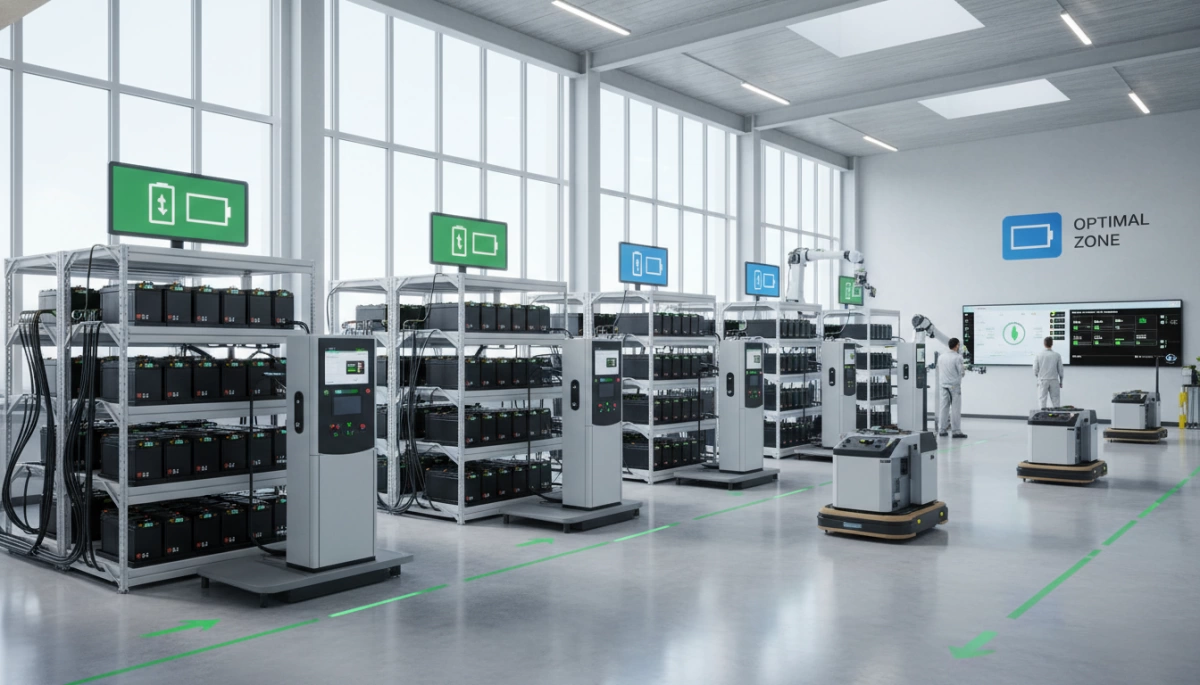
When we talk about warehouse battery charging optimization for multi-shift operations, layout is where the money is either made or wasted. The way you design your forklift charging setup directly hits uptime, safety, and your energy bill.
Warehouse charging station layout best practices
Keep it simple, visible, and close to traffic flow:
- Put charging areas on natural routes (near dock doors, staging, or break rooms), not in dead corners.
- Use clear floor markings for parking, walking, and no‑go zones around chargers.
- Separate lead‑acid charging (gassing, watering) from clean areas and lithium‑ion charging if you mix chemistries.
- Standardize the layout at every station: same side for plugs, same signage, same safety gear.
If you’re evaluating different layouts or technologies, it helps to look at real project examples in dedicated forklift lithium battery solutions sections like the ones in the industrial battery product category.
Locating chargers to cut travel and idle time
In multi-shift forklift operations, every extra minute of travel to a charger is paid for three times a day:
- Place chargers near high-traffic zones and driver changeover points, not just in one “battery room.”
- Avoid dead-end aisles; operators should be able to drive in and out without reversing around people.
- For large sites, add multiple small charging clusters instead of a single massive station.
Ventilation, spacing, and cable management for safety
Safety and uptime go hand in hand:
- For lead-acid forklift batteries, provide strong ventilation to clear hydrogen gas; never block airflow around chargers.
- Keep minimum spacing between chargers and between trucks to prevent bumps and allow service access.
- Use overhead cable reels, floor guards, or posts so cables don’t become trip hazards or get crushed by pallets.
- Put spill kits, eyewash, fire extinguishers, and PPE right at the charging zone, not in a separate room.
For more technical breakdowns on cooling, spacing, and wiring setups, I often reference detailed guides and case studies in specialized battery technology blogs and resources.
Centralized vs decentralized charging zones
Both models can work; the right choice depends on your warehouse size and shift pattern:
-
Centralized charging
- Better for tight control, maintenance, and inspections.
- Often preferred for large lead-acid fleets with battery swapping.
- Downside: more travel time and congestion at shift changes.
-
Decentralized charging
- Multiple charging points closer to the work.
- Ideal for lithium-ion forklift batteries and opportunity charging.
- Less congestion, better for 24/7 operations, but you need consistent standards at every point.
Most multi-shift sites end up with a hybrid: one main zone plus a few satellite charging points.
Planning power capacity for peak charging periods
Ignoring power capacity is how you blow fuses and spike demand charges:
- Map when trucks plug in by shift; your real risk is everyone charging at once (end of shift + breaks).
- Size electrical panels and wiring for peak load, not average.
- Use smart battery chargers and timers to:
- Stagger start times for fast charging industrial batteries.
- Shift heavy charging away from peak utility hours where possible.
- If you’re expanding your electric fleet, plan extra capacity now; upgrading infrastructure later is always more expensive.
Design the charging setup as seriously as you design your picking or staging layout, and you’ll cut forklift battery downtime, lower energy costs, and make the place safer to work in.
Using Data and Battery Management Systems
In multi-shift warehouses, guessing is expensive. Using data and a solid battery management system (BMS) is how you actually optimize warehouse battery charging instead of just reacting when a truck dies in the aisle.
What a BMS Does in a Warehouse
A good battery management system for warehouse fleets gives you:
- Live visibility of every battery and truck
- Clear rules for forklift battery charging schedules
- Traceable data for uptime, maintenance, and energy cost
Think of it as the control center for your multi-shift forklift operations, especially if you’re running mixed lead-acid and lithium-ion forklift batteries from suppliers like Xichai’s industrial battery range.
Real-Time Monitoring: SoC, Temperature, and Usage
Real-time monitoring is non‑negotiable if you want true warehouse battery charging optimization:
- State of Charge (SoC): See which batteries are actually ready, which are low, and which are being abused
- Temperature: Spot overheating early, especially with fast charging industrial batteries
- Cycle count and depth of discharge: Track how hard each battery is being pushed across shifts
This alone can cut forklift battery downtime and keep operators from running batteries too deep.
Predictive Battery Maintenance
With real data, you move from “fix when it fails” to predictive battery maintenance:
- Automatic flags for batteries that drop voltage too fast
- Alerts when lead-acid forklift batteries keep missing equalization cycles
- Early warnings on lithium packs that show abnormal heat or imbalance
That means fewer surprise failures in peak hours and cleaner forklift battery lifecycle management.
Integrating with WMS and Fleet Systems
To get real value, plug your battery data into your existing systems:
- Connect to your warehouse management system (WMS) and fleet software
- Match charging events to shift patterns, orders, and truck utilization
- Link kWh use to SKUs, zones, or pallets moved for better warehouse energy management
This is where battery charging downtime reduction turns into real cost per pallet and cost per hour insights.
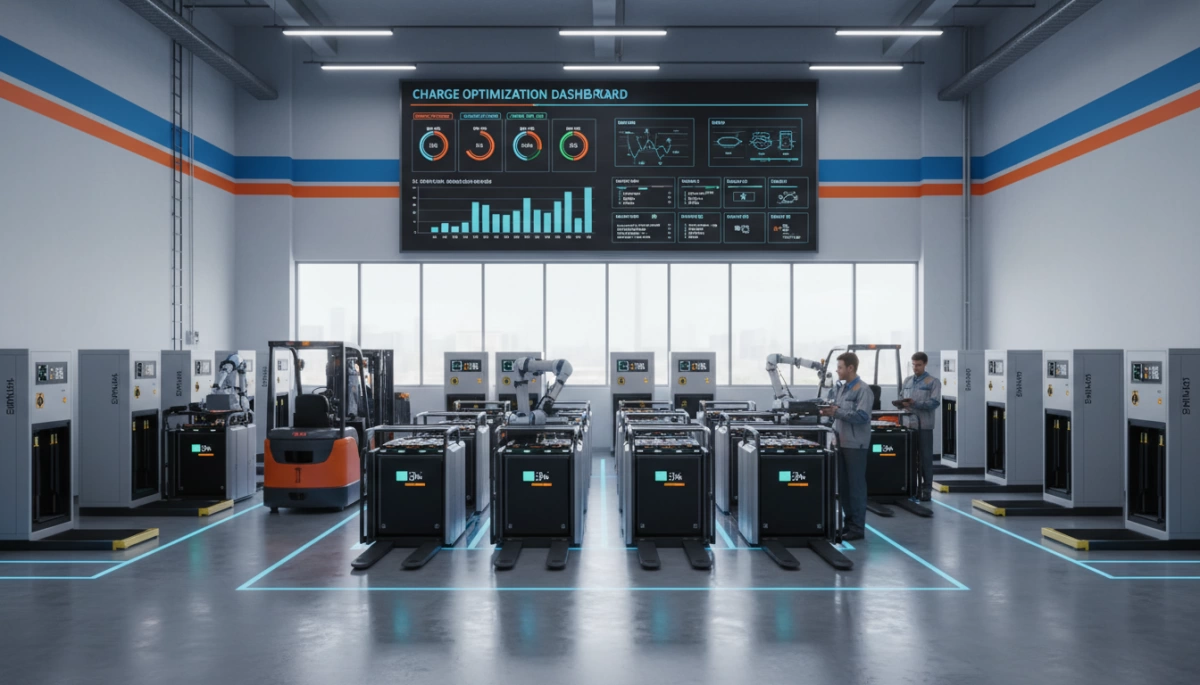
Alerts, Reports, and Dashboards That Matter
I focus on a handful of views that actually drive decisions:
-
Live dashboard:
- Batteries below safe SoC
- Overheated or faulted chargers
- Trucks operating with low battery risk
-
Daily/weekly reports:
- Deep discharge events by shift
- Idle chargers vs overloaded chargers
- Batteries nearing end of life
-
Simple alerts:
- “Don’t dispatch Truck 12 – battery below X%”
- “Battery #34 missed last equalization”
- “Peak-demand charging window exceeded”
If you’re upgrading to smart battery chargers for forklifts or planning a lithium rollout, pair them with a strong BMS from the start. It’s the fastest way to bring discipline, safety, and cost control to 24/7 warehouse operations charging, and it’s exactly the kind of approach we design for our own warehouse battery solutions.
Optimization Tactics for Multi-Shift Charging
Clear charging rules by shift and role
In multi-shift forklift operations, guessing is what kills batteries and uptime. I set simple, written rules for each shift and role so nobody has to think twice:
- By shift:
- End of shift: park at the assigned warehouse charging station and plug in, no exceptions.
- Mid-shift: only charge during planned windows (breaks, lunch, driver changeover).
- By role:
- Operators: follow the forklift battery charging schedule and never bypass safety steps.
- Supervisors: enforce rules, check compliance, and flag repeat issues.
- Maintenance: monitor battery management system (BMS) data and adjust rules based on real usage.
I keep the rules visible at each industrial battery charging station and inside the WMS / fleet app so they stay top-of-mind.
Simple charging schedules teams actually follow
Complex schedules don’t work on a busy floor. I keep warehouse battery charging optimization simple:
- Fixed charging windows per shift (e.g., first break, lunch, end of shift).
- Clear State of Charge (SoC) thresholds:
- Lead-acid: plug in around 30–40% SoC.
- Lithium-ion: plug in anytime under 60–70% SoC during breaks.
- One-page cheat sheet per site with:
- Shift times
- When to charge
- Which chargers to use
Local teams in each region can tweak these within a common global standard, but the idea stays the same: simple, repeatable, enforceable.
Using opportunity charging during breaks and handovers
Opportunity charging for warehouses is where multi-shift sites win. I design the operation so:
- Chargers sit near canteens, time clocks, and driver rooms.
- Operators are trained:
- If you park for 10+ minutes, plug in.
- Always plug in on breaks and shift changeovers.
- For lithium-ion forklift batteries, this is the main strategy—many short, quick top-ups instead of full overnight charges.
- For lead-acid forklift batteries, I limit opportunity charging and keep it consistent to protect battery life and warranty.
Done right, this cuts forklift battery downtime without adding headcount.
Avoiding deep discharges that kill battery life
Deep discharges quietly blow up your total cost of ownership. I set hard limits:
- For lead-acid:
- Never run below 20% SoC (≈80% depth of discharge).
- Set BMS or truck limits so trucks slow down before that point.
- For lithium-ion:
- You can go deeper, but I still avoid below 10–20% SoC as a habit to extend life.
- I use smart battery chargers for forklifts and BMS alerts:
- Email / app alerts if a truck hits critical low SoC.
- Weekly report on how often each truck hits “red zone”.
This one rule alone often adds 1–2 years of extra battery life in high-utilization fleets.
Rotating batteries to balance wear across the fleet
If a few trucks or batteries work harder than the rest, you pay for replacements early. I bake battery rotation into daily routines:
- Use “first in, first out” rules in swap areas for lead-acid.
- Label batteries and trucks clearly and track cycles per battery via the battery management system warehouse platform.
- Flag:
- Any battery with much higher cycle count than the fleet average.
- Any truck that always uses the same battery.
- For lithium-ion, if packs are fixed to trucks, I balance workloads by:
- Rotating heavy and light tasks across trucks.
- Reassigning trucks between zones and shifts.
Balanced use means fewer surprise failures, smoother forklift fleet optimization, and predictable replacement planning.
Lithium-Ion Advantages for Multi-Shift Warehouses
When we talk about warehouse battery charging optimization for multi-shift operations, lithium-ion is usually the easiest win. It fits how modern 2–3 shift and 24/7 sites actually run.
Why lithium-ion fits multi-shift forklift operations
In busy global warehouses, trucks can’t sit around waiting for batteries. Lithium-ion forklift batteries are built for multi-shift forklift operations because they:
- Handle multiple partial charges per day without damage
- Deliver full power until the end of the shift
- Work great with opportunity charging for warehouses during breaks and changeovers
This makes your forklift fleet optimization much simpler.
Faster charging, no cooldown, no gassing
With lithium, fast charging industrial batteries becomes realistic:
- 1–2 hours to get back to a high state of charge
- No required cooldown time
- No gassing, so no special ventilation rooms
You can top up during coffee breaks and lunch, which is key for 24/7 warehouse operations charging.
Consistent power with no voltage sag
Unlike lead-acid forklift batteries, lithium keeps a stable voltage:
- No sluggish trucks at the end of the shift
- Better lift and travel speed consistency
- Smoother workflows in high-throughput zones (picking, loading, cross-dock)
That directly cuts forklift battery downtime and keeps operators productive.
Lower maintenance, no watering or equalization
Lithium cuts out most of the annoying battery work:
- No watering, no acid checks
- No battery equalization charging routines
- Fewer service calls and simpler battery lifecycle management
For global operations, this means less skill-dependence and fewer training headaches.
Space and labor savings from simpler charging setups
With lithium, warehouse charging station layout becomes lean:
- No dedicated battery swap rooms
- Fewer spare batteries per truck
- Smaller, cleaner warehouse charging stations with smart battery chargers
You save floor space, cut labor tied to battery swaps, and streamline industrial battery charging infrastructure for modern warehouse energy management.
When to Switch from Lead-Acid to Lithium-Ion
Red flags your lead-acid setup is maxed out
In multi-shift forklift operations, I know it’s time to look at lithium-ion when I see:
- Trucks waiting for charged batteries during peak hours
- Constant battery swapping tying up operators and extra staff
- 3+ batteries per truck just to keep up with 2–3 shifts
- High maintenance time (watering, cleaning, equalization)
- Frequent voltage sag and operators complaining about “weak trucks” at end of shift
- Shortened battery life (replacements in under 4–5 years in heavy use)
- Charging rooms eating up valuable floor space
If you’re seeing most of these, your current warehouse battery charging optimization is at its limit.
Cost comparison: lead-acid vs lithium in multi-shift use
For 2–3 shift or 24/7 warehouses, lithium-ion forklift batteries usually change the math:
-
Lead-acid forklift batteries
- Lower upfront battery price
- Need 2–3 batteries per truck for multi-shift
- Extra chargers, swap room, battery handling equipment
- Higher labor costs for swapping and maintenance
- More unplanned downtime from undercharged or damaged batteries
-
Lithium-ion forklift batteries
- Higher upfront battery + charger cost
- Typically 1 battery per truck, even in 24/7 use
- Minimal maintenance, no watering or equalization
- Smaller charging footprint, no dedicated swap room
- Better support for opportunity charging for warehouses with tight break windows
When I run full forklift fleet optimization models, lithium often wins in high-uptime environments, even with a higher sticker price.
How total cost of ownership (TCO) changes with lithium
Total cost of ownership shifts in four main areas:
- Fewer batteries and chargers: 1 lithium battery vs 2–3 lead-acid per truck
- Lower labor: no swap labor, no watering, less cleaning and inspections
- Less downtime: more consistent power, fewer mid-shift battery issues
- Lower facility costs: smaller or no battery room, simplified industrial battery charging infrastructure
Over 5–10 years, lithium-ion in multi-shift forklift operations usually delivers:
- Lower cost per operating hour
- Lower kWh per pallet moved, thanks to higher efficiency
Payback timelines for busy warehouses
For 2–3 shift or 24/7 warehouse battery charging optimization, payback isn’t theoretical; it’s measurable:
- Single-shift, light use: lithium payback can be long or not worth it
- Two-shift operations: typical payback in 3–5 years, depending on labor and energy rates
- Three-shift / 24/7 sites: I often see payback in 2–4 years once you count:
- Reduced batteries and chargers
- Removal of battery swap equipment
- Labor saved on swapping and maintenance
- Lower downtime and higher throughput
Global customers with high energy prices or expensive labor usually hit payback faster.
Operational benefits beyond battery life
Lithium-ion forklift batteries do more than last longer:
-
True opportunity charging
- Charge during breaks, driver changeovers, and micro-gaps
- No cooldown, no gassing, no equalization charging
-
Consistent performance
- No voltage sag at the end of the shift
- Better control in racking, cold rooms, and tight spaces
-
Simpler warehouse charging station layout
- Chargers near docks or pick paths
- Less traffic to remote battery rooms
- Lower risk around cables and battery handling
-
More flexible energy management
- Easier to stagger fast charging industrial batteries
- Better alignment with warehouse energy management and off-peak tariffs
If your goal is forklift battery downtime reduction, cleaner operations, and higher throughput per m², switching from lead-acid to lithium-ion is usually the turning point.
Step-by-Step Plan for Warehouse Battery Charging Optimization
1. Audit your forklift fleet and shift utilization
I start with a simple audit of the fleet and how it runs across shifts:
- List every truck, battery type (lead-acid or lithium-ion), capacity, age, and charger type.
- Track hours run per shift, per truck, for at least 2–4 weeks.
- Flag high-usage trucks in multi-shift forklift operations that regularly run close to empty.
This shows where warehouse battery charging optimization will have the biggest impact.
2. Map current charging habits and downtime hotspots
Next, I map what actually happens today:
- When and where do operators plug in? End of shift only, or chance/opportunity charging during breaks?
- How often does a truck sit idle waiting for a charged battery?
- Which zones of the warehouse see the most forklift battery downtime?
I use that to pinpoint bad habits and quick wins—like missed opportunity charging or long walks to chargers.
3. Right-size chargers and batteries to workloads
Then I match hardware to reality:
- Check if batteries are correctly sized for each route/shift pattern.
- Confirm if existing chargers can support opportunity charging or if fast charging industrial batteries is needed.
- For lead-acid: ensure enough chargers and swap batteries to cover 2–3 shifts.
- For lithium-ion: verify chargers are placed where trucks actually stop.
This step keeps you from overspending while still supporting 24/7 operations.
4. Pilot a new charging schedule on a small group
I never roll out changes to the whole warehouse at once:
- Select 3–5 trucks from different shifts and workloads.
- Set clear forklift battery charging schedules: when to plug in (breaks, shift change, lunch), minimum state-of-charge to plug in, and rules to avoid deep discharge.
- Run the pilot for 4–6 weeks and track uptime, charge times, and operator feedback.
This proves what works before you invest across the fleet.
5. Roll out clear operator training
Once the pilot is solid, I train operators and supervisors:
- Simple rules by shift: “If SOC < X% at break, plug in here.”
- Visual guides at warehouse charging stations showing which charger for which truck.
- Safety basics: cabling, PPE, parking positions, and forklift battery safety guidelines.
The goal is a charging routine people can follow without thinking too hard.
6. Set up simple KPIs to track uptime and energy use
To keep warehouse battery charging optimization on track, I lock in a few KPIs:
- Truck uptime % per shift
- Battery-related downtime (minutes per truck per week)
- kWh per operating hour or kWh per pallet moved
- Average depth of discharge for lead-acid and lithium-ion forklift batteries
With smart battery chargers and a battery management system in the warehouse, these metrics are easy to track and help you continuously improve your multi-shift warehouse battery strategy.
Energy management and utility cost control
In multi-shift forklift operations, warehouse battery charging optimization is as much about your power bill as it is about uptime. I treat charging like any other utility load: measured, scheduled, and controlled.
How charging timing hits your energy bill
If you’re in Europe, North America, or most Asia-Pacific markets, your utility likely uses time-of-use tariffs and demand charges. That means when you charge matters as much as how much you charge.
- Avoid stacking multiple fast charging industrial batteries at the same time during peak hours.
- Push bulk charging into off‑peak or shoulder periods whenever your shifts allow.
- For 24/7 sites, use opportunity charging for warehouses during low-tariff windows (e.g., night or early morning).
I’ve seen global customers cut 10–25% off their energy spend just by shifting charging windows without touching the fleet size.
Staggering fast charging to cap peak demand
Multi-shift forklift operations love fast charging, but if you light up every smart battery charger at once, your demand spike will hurt.
- Set charger start delays so not all units fire at the same minute.
- Cap the maximum chargers allowed in “fast charge” mode at any one time.
- Prioritize trucks with lowest state of charge and critical tasks (shipping, inbound) during high-demand periods.
Think of it as a queue system: keep trucks moving, but never slam your site with full load at once.
Using smart chargers and timers
With smart battery chargers for forklifts, I automate as much as possible so operators don’t have to think about tariffs or schedules.
- Program timers so full-charge cycles start in off‑peak hours.
- Use load‑balancing modes that throttle output when too many chargers are active.
- Lock in simple charging rules: plug in on break, system decides when and how hard to charge.
This is the backbone of warehouse battery charging optimization for multi-shift operations: remove guesswork from the floor.
Integrating with energy management systems
If your facility already runs a building or energy management system, tie your battery strategy into it.
- Feed real-time charger load into the site EMS.
- Let the EMS shed or slow charging automatically when the plant’s total kW approaches your demand threshold.
- Use EMS data to plan future charger locations and power capacity.
Global customers doing this see far fewer surprise overage fees and can plan expansions without electrical chaos.
Tracking kWh per pallet or hour
To keep this honest, I track energy intensity, not just total kWh.
- kWh per pallet moved – best for high-volume distribution centers.
- kWh per operating hour per truck – useful for comparing sites and shift patterns.
- Combine with forklift battery downtime reduction metrics to see if lower energy use is hurting or helping productivity.
Once you see clear numbers, decisions like lead-acid vs lithium battery charging, more opportunity charging, or extra chargers stop being guesses and start being ROI discussions.
Safety and Compliance in Charging Areas
In multi-shift forklift operations, warehouse battery charging optimization only works if the charging area is safe and compliant. If safety slips, you lose uptime, face fines, and put people at risk.
OSHA and Local Code Basics
For any warehouse charging station (lead-acid or lithium-ion):
- Keep charging areas clearly marked and designated just for charging.
- Follow OSHA / local electrical codes for:
- Proper ventilation (especially for lead-acid forklift batteries that off-gas hydrogen).
- Correct breaker sizes, wiring, and grounding for industrial battery charging infrastructure.
- Clear emergency access and fire protection (extinguishers, eyewash where needed).
- Never let extension cords replace fixed charging circuits.
If you’re global, always align with your local standards on top of OSHA-style best practices.
PPE, Signage, and Clear Walkways
Your forklift battery safety guidelines should be simple and non-negotiable:
- PPE for lead-acid:
- Safety glasses or face shield
- Acid-resistant gloves
- Apron when handling or topping up
- Signage:
- “Charging Area – No Smoking / No Sparks”
- Voltage, hazard, and PPE icons near each smart battery charger.
- Walkways:
- Mark safe walking lanes with floor tape.
- No pallets, no empty skids, no random storage in the charging zone.
Handling Acid Spills, Off-Gassing, and Heat
For lead-acid forklift batteries in multi-shift operations:
- Acid spills:
- Keep spill kits (neutralizer, absorbents) right in the charging area.
- Train staff exactly who cleans what and when to escalate.
- Off-gassing:
- Ventilate to keep hydrogen below explosive limits.
- Don’t block airflow with boxes, racks, or shrink wrap.
- High temperatures:
- Stop charging if batteries or chargers overheat.
- Use your battery management system or chargers with temp alarms.
Lithium-ion doesn’t have acid or normal gassing, but you still need temperature control and fire-safe practices.
Safe Cable Routing and Impact Protection
To avoid trips, damage, and downtime:
- Route charging cables overhead or with floor guards.
- Keep connectors off the floor and away from impacts.
- Use strain relief and protect cables near corners and doors.
- Make it easy for operators to connect/disconnect without stretching or stepping over cables.
This is a big lever for forklift battery downtime reduction and avoiding minor but costly incidents.
Daily and Weekly Safety Checks
Bake quick checks into your multi-shift forklift operations routine:
Daily (by operators or shift leads):
- Check for damaged cables, cracked plugs, and loose connectors.
- Confirm chargers are mounted correctly and ventilation is clear.
- Verify PPE and spill kits are in place and not empty.
Weekly (by maintenance or supervisor):
- Inspect all chargers and labels for wear or damage.
- Test emergency stops and check fire extinguishers are accessible.
- Review any incidents or near-misses in the charging area.
When we standardize these checks across sites, safety issues drop and warehouse battery charging optimization actually sticks.
Tracking Results and Continuous Improvement
When we talk about warehouse battery charging optimization for multi-shift operations, I don’t leave performance to guesswork. I track it, adjust it, and scale what works.
Key metrics for forklift battery downtime reduction
To cut forklift battery downtime, I focus on a small set of hard numbers:
- Unplanned battery-related downtime per truck (hrs/week)
- Number of “battery dead” events per shift
- Average state of charge (SoC) at start/end of each shift
- Charging time vs operating time ratio
- Battery-related delays at shift change or breaks
If these numbers trend down, our forklift fleet optimization is working.
Monitoring battery health and replacement cycles
For both lead-acid forklift batteries and lithium-ion forklift batteries, I put structure around battery lifecycle management:
- Track charge cycles, depth of discharge, and temperature events
- Log equalization charging (for lead-acid) and check if it actually helps
- Use a battery management system (BMS) or smart charger data to flag:
- Capacity loss
- Voltage drops
- Overheating trends
This keeps replacement predictive, not reactive, and protects total cost of ownership.
Comparing productivity before and after optimization
To prove warehouse battery charging optimization is paying off, I compare:
- Pallets moved per labor hour before vs after new charging rules
- Truck utilization rate (how many hours per shift each truck actually runs)
- Energy cost per operating hour or per pallet moved
- Battery swap / charging delays per shift
A simple before/after dashboard tells me if our new forklift battery charging schedule and opportunity charging rules are worth keeping.
Using data to refine shift-based charging rules
I don’t set rules and forget them. I refine them based on real usage:
- If batteries are coming back too low → tighten opportunity charging during breaks
- If SoC is always high → reduce overcharging and save energy
- If one shift is abusing batteries (deep discharges) → adjust training and rules for that shift
- Use BMS alerts to tweak 2-shift vs 3-shift charging patterns
The goal is simple: more uptime, less stress on batteries.
Scaling best practices across multiple sites or regions
For global and multi-site operations, I standardize what works and localize the rest:
- Create a global playbook for:
- Warehouse charging station layout
- forklift battery safety guidelines
- smart battery chargers configuration
- Roll out common KPIs (downtime, kWh per pallet, battery life) across regions
- Keep flexibility for:
- Local energy tariffs
- Different shift models (24/7, 2-shift, peak seasons)
- Mix of lead-acid vs lithium battery charging
Once the data proves a best practice in one warehouse, I replicate it across the network and keep tuning based on local results. This is how I turn multi-shift warehouse battery strategy into a scalable, data-driven system.
Forklift Battery Runtime Calculator: Capacity & Working Hours Guide
5 Forklift Battery Warning Signs Technicians Often Miss