How Much Electricity Does a Forklift Use? Energy Cost Calculator and Formulas
Short answer: A 3-ton electric counterbalance forklift draws roughly 4–8 kWh per operating hour. An electric pallet jack draws about 0.8–2 kWh per hour. Over a two-shift year, that works out to roughly 18,000 kWh (about $2,300 at $0.13/kWh) per counterbalance truck on lead-acid — and about 17% less on lithium, purely from charging efficiency.
Below are the formulas behind those numbers, two worked examples you can copy for your own fleet, and the reason the same truck costs different amounts to run depending on which battery chemistry is in it.
How to calculate forklift energy consumption
There are two ways to answer "how much electricity does a forklift use." Use whichever matches the data you have.
Method 1 — From the battery (most accurate)
This is the better method because it accounts for charging losses, which are invisible if you only look at the truck.
Pack energy (kWh)  = Voltage x Amp-hours / 1000
Usable energy (kWh) = Pack energy x Depth of Discharge
Grid energy (kWh)   = Usable energy / Charging efficiency
The last line is the one most fleets forget. The energy your utility bills you for is not the energy the truck used — it is the energy the truck used plus everything lost as heat in the charger and the battery.
Method 2 — From operating hours
Daily energy (kWh) = Operating hours x Average power draw (kW)
Average power draw is the number most people do not have. As a starting point:
| Truck class | Typical pack | Average draw |
|---|---|---|
| Class III electric pallet jack | 24V, 150–250Ah | 0.8–2 kW |
| Class II reach truck / order picker | 24–48V, 500–700Ah | 2–5 kW |
| Class I counterbalance (2–3 t) | 48V, 600–800Ah | 4–8 kW |
| Class I counterbalance (4–5 t) | 80V, 500–700Ah | 7–12 kW |
Treat these as opening estimates, not specifications. Actual draw swings widely with lift height, load weight, travel distance, ramp grade, and — significantly — cold storage operation.
Worked example: 48V counterbalance, two shifts
A 3-ton counterbalance truck with a 48V 750Ah lead-acid battery, running two shifts a day, 250 days a year:
Pack energy   = 48V x 750Ah / 1000        = 36.0 kWh
Usable (80% DoD, lead-acid limit)         = 28.8 kWh
Grid energy   = 28.8 / 0.80 charge eff.   = 36.0 kWh per charge
Cost per charge at $0.13/kWh              = $4.68
Annual (2 shifts x 250 days = 500 charges) = 18,000 kWh = $2,340
Note what happened in line three: because lead-acid charging is only about 80% efficient, you pull a full 36 kWh off the grid to put 28.8 kWh of usable work into the truck. You pay for 36, you use 28.8.
Worked example: 24V electric pallet jack
A 24V 200Ah pallet jack battery:
Pack energy = 24V x 200Ah / 1000 = 4.8 kWh
Usable at 80% DoD                = 3.84 kWh
At 1.2 kW average draw           = about 3.2 hours of continuous work
Three hours sounds low, and it is — until you account for duty cycle. A pallet jack in a picking operation is idle far more than it is moving. Most single-shift picking operations get a full shift out of a pack like this. Multi-shift operations usually do not, which is where the change-out-versus-opportunity-charging decision starts.
If you need to size a pack for a specific shift pattern rather than estimate an existing one, our forklift battery runtime calculation and capacity guide walks through the sizing math in detail.
Turning kWh into dollars
Annual cost = Grid kWh per charge
              x Charges per day
              x Operating days per year
              x Your electricity rate
Two things distort this more than anything else:
Your actual rate, not the average. US commercial electricity averages around $0.13/kWh, but the real range across states is roughly $0.08 to $0.30. Using a national average on a California or Northeast site will understate your cost by a wide margin.
Demand charges. Many commercial tariffs bill partly on peak kW, not just total kWh. If your entire fleet plugs in at 6pm shift change, you are creating a demand spike that can cost more than the energy itself. Staggering charge start times often saves more money than any efficiency measure.
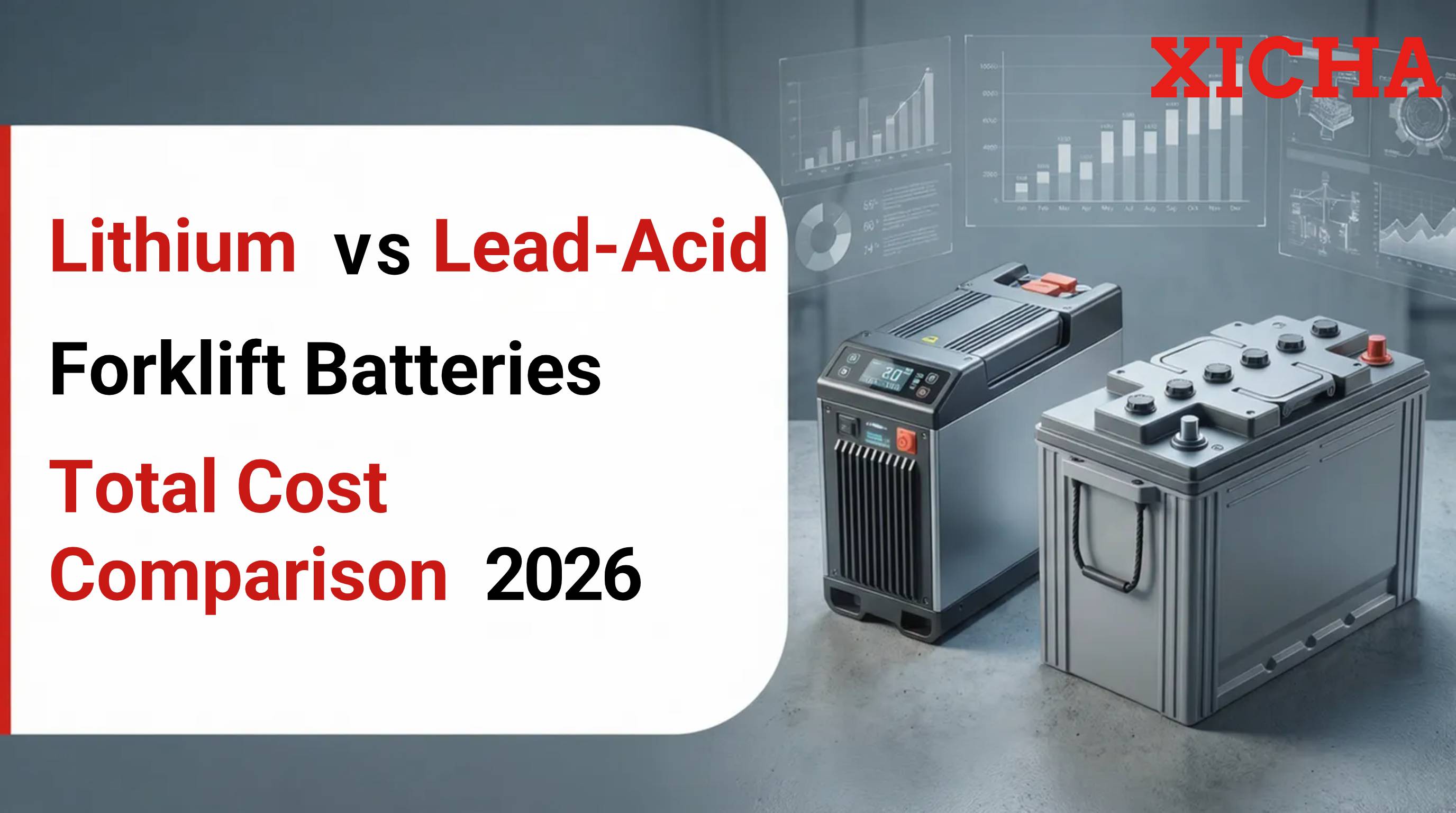
Why lead-acid costs more per shift than lithium
This is the part that does not show up in a spec sheet comparison. Same truck, same work, different energy bill:
| Lead-acid | LiFePO4 | |
|---|---|---|
| Charging efficiency | 75–85% | 95–98% |
| Practical depth of discharge | 80% max | 80–100% |
| Grid kWh to deliver 28.8 kWh usable | 36.0 kWh | 30.0 kWh |
| Difference per charge | — | 6.0 kWh saved |
Across 500 charges a year that is 3,000 kWh, or about $390 per truck per year at $0.13/kWh — roughly a 17% reduction in electricity cost, before counting anything else.
Two caveats worth stating plainly. First, $390 a year per truck does not by itself justify a lithium conversion; the case for lithium is usually built on labor, battery change-out time, and cycle life, with energy savings as a secondary line item. Second, lead-acid also requires periodic equalisation charges, which consume energy without delivering usable work — so the real-world gap is somewhat wider than the table shows.
If you are building a full comparison, the chemistry differences are covered in our lithium forklift battery overview.
Forklift hours to miles: what the conversion is actually for
A common question from fleets moving from automotive maintenance thinking to material handling: how do forklift hours translate to miles?
The rule of thumb used across the industry is 1 forklift hour is roughly equivalent to 25–35 miles of vehicle wear. So a truck showing 2,000 hours on the meter has accumulated wear broadly comparable to a car with 50,000–70,000 miles.
Be clear about what this conversion is and is not. It is a maintenance-planning heuristic — a way to translate hour-meter readings into service-interval intuition you already have. It is not a measure of distance travelled, and it is not a basis for energy calculations. For energy, use kWh; hours-to-miles will mislead you, because a truck doing high-lift work in a tight aisle burns significant energy while travelling almost no distance.
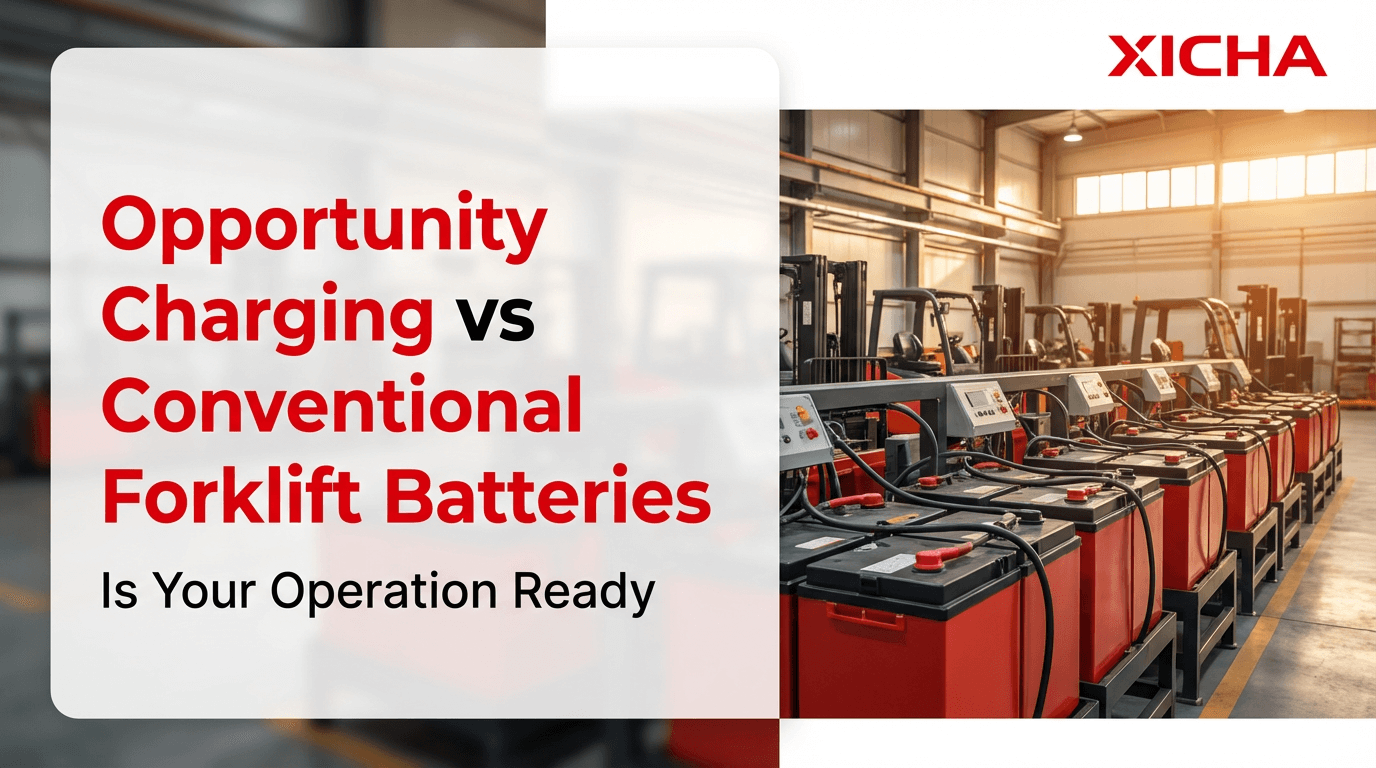
How opportunity charging changes the arithmetic
Opportunity charging — topping up during breaks rather than running a pack down and swapping it — changes the calculation in ways that are not obvious:
- Total kWh barely moves. The work is the same, so the energy is roughly the same.
- Peak demand can rise sharply. More chargers running during the day means a higher simultaneous load.
- It eliminates spare packs, which removes both capital cost and the labour of change-outs.
- It is chemistry-dependent. Lithium tolerates partial-state-of-charge cycling well. Lead-acid does not — frequent partial charging without full absorption cycles accelerates sulfation and shortens pack life.
The honest summary: opportunity charging is a labour and capital decision far more than an energy decision. If someone presents it to you primarily as an electricity saving, the business case is being built on the wrong line item.
How to measure your own fleet instead of estimating
Every number above is an estimate. If energy cost is material to your operation, measure it — it is neither difficult nor expensive:
- Put a kWh meter on the charger circuit. A clamp meter or plug-in energy monitor on one representative truck for two weeks gives you a real number, including charging losses.
- Log hour-meter readings at the same time. Grid kWh divided by operating hours gives your actual kWh-per-hour figure.
- Repeat per truck class and per shift pattern. A cold-storage reach truck and an ambient-temperature pallet jack will not behave alike, and averaging them hides the trucks that are actually costing you money.
- Check the bill for demand charges. If peak kW appears as a line item, your charging schedule may matter more than your charger efficiency.
Frequently asked questions
How much electricity does a forklift use per hour?
Typically 4–8 kWh per hour for a 3-ton electric counterbalance truck, and 0.8–2 kWh per hour for an electric pallet jack. Cold storage, high-lift work, and heavy loads push these figures toward the top of the range and beyond.
How do I calculate my forklift's energy cost?
Multiply pack voltage by amp-hours, divide by 1000 for pack kWh, multiply by your depth of discharge for usable energy, then divide by charging efficiency to get grid energy. Multiply that by charges per year and your electricity rate.
Is a forklift cheaper to run than a propane truck?
On energy cost alone, electric is usually cheaper — but the margin depends heavily on your local electricity and propane rates, both of which move. The more durable advantages of electric are lower maintenance and no indoor emissions, not a fixed fuel saving.
How many hours does a forklift battery last per charge?
Usually one full shift for a correctly sized pack in a single-shift operation. Multi-shift operations generally need either a spare pack or opportunity charging. Sizing this properly is covered in the runtime and capacity guide.
Does battery voltage affect energy consumption?
Not directly — the work done sets the energy required. Higher voltage systems deliver the same power at lower current, which reduces resistive losses and heat, so a 80V system is marginally more efficient than a 24V system doing identical work. The effect is real but small compared with charging efficiency.
XICHA manufactures lead-acid and LiFePO4 traction batteries and chargers for material handling equipment, in 24V, 48V and 80V configurations, including electric pallet jack batteries. If you want help sizing a pack or building an energy cost model for your fleet, get in touch with your truck models and shift pattern.
Forklift Fleet Electrification with Lithium Batteries for Higher Uptime and ROI