When To Repair vs. Replace Your Forklift Battery

Professional forklift battery maintenance is essential for maximizing lifespan and performance
Understanding Forklift Battery Lifespan and Value
Forklift batteries are a significant investment in your material handling operations. With proper care and maintenance, a quality lead-acid forklift battery can deliver reliable service for 8-10 years or approximately 1,500-2,000 charge cycles. However, without adequate maintenance, that same battery may fail in as little as 3-5 years, forcing premature replacement and impacting your bottom line.
Given that a forklift battery can represent 25-30% of the total vehicle cost (ranging from $3,000 to $15,000+ depending on capacity and type), understanding when to repair versus replace becomes crucial for fleet management and cost control.
Essential Forklift Battery Maintenance: Dos and Don'ts
Proper maintenance is the foundation of battery longevity. Following these best practices can significantly extend your battery's operational life and help you avoid premature replacement costs.
✅ DO These Things
- Charge at 20%: Start charging when battery is about 20% full.
- Keep the right temperature: Use in areas around 77°F (25°C) for lead-acid batteries.
- Complete charging: Ensure batteries reach 100% before disconnecting.
- Regular maintenance: Clean and inspect monthly.
- Check water weekly: Keep proper water levels in flooded lead-acid batteries.
- Use lifting equipment: Always use proper tools to handle batteries.
❌ DON'T Do These Things
- Partial charging: Avoid charging during short breaks.
- Mid-shift swaps: Don’t change batteries mid-shift unless necessary.
- Manual lifting: Never lift a battery without proper equipment.
- Extreme temperatures: Avoid using in very hot or cold conditions.
- Skip maintenance: Don’t delay scheduled cleaning and inspections.
Avoid overcharging or undercharging: Don’t leave batteries on chargers too long or remove before fully charged.
Important: Clean your battery every month with special cleaning solutions. This helps stop harmful chemicals from building up, which can cause the battery to fail early and create safety risks.

Regular maintenance checks help identify issues before they become costly problems
Warning Signs: When Your Forklift Battery Needs Attention
Recognizing early warning signs can help you determine whether repair or replacement is the most cost-effective solution. Here are the key indicators to monitor:
Performance-Related Warning Signs
- Reduced runtime: Battery only runs for a few hours per charge instead of a full shift
- Slow charging: Takes significantly longer to reach full charge than when new
- Frequent low-battery warnings: Battery indicator shows low charge more frequently
- Reduced lifting capacity: Forklift struggles with loads it previously handled easily
- Inconsistent power delivery: Noticeable power fluctuations during operation
Physical Warning Signs
- Visible corrosion: White, blue, or green buildup around terminals
- Cracked or damaged casing: Physical damage to the battery housing
- Electrolyte leakage: Acid leaks or unusual moisture around the battery
- Swollen or bulging cells: Individual cells appear distorted or enlarged
- Excessive heat generation: Battery becomes unusually hot during charging or operation
Diagnostic Testing: Repair vs. Replace Decision Matrix
When warning signs appear, systematic testing helps determine the most cost-effective course of action. Follow this diagnostic approach:
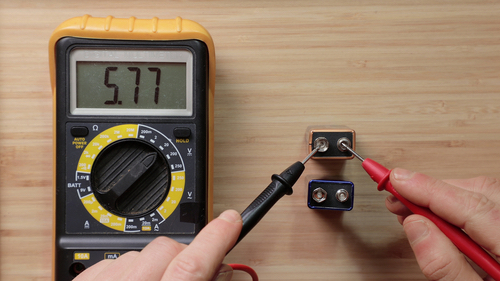
Voltage testing with a multimeter is essential for accurate battery diagnosis
Step 1: Visual and Physical Inspection For Forklift Parts
Check cables and connectors first: Often, performance issues stem from loose connections, corroded terminals, or damaged cables. These are typically inexpensive repairs that can restore full functionality.
- Inspect all cable connections for tightness and corrosion
- Look for physical damage to cables, connectors, or housing
- Check for proper cable routing and strain relief
- Examine battery casing for cracks, leaks, or swelling
Step 2: Voltage Testing
Use a digital multimeter to test individual cell voltages:
- Healthy cells: Should read 2.0-2.1 volts per cell when fully charged
- Questionable cells: Readings below 1.8V or above 2.3V indicate potential problems
- Failed cells: Readings significantly different from other cells (±0.2V variance)
Step 3: Specific Gravity Testing (Lead-Acid Batteries)
Test electrolyte specific gravity with a hydrometer:
- Optimal range: 1.265-1.285 for fully charged cells
- Concerning readings: Below 1.15 or above 1.29
- Replace if: Multiple cells show readings outside the acceptable range
Safety First: Always ensure the battery is fully charged before conducting specific gravity tests. Wear appropriate PPE including safety glasses, acid-resistant gloves, and protective clothing.
Cost Analysis: Repair vs. Replacement
Financial Decision Framework
Use this cost-benefit analysis to make informed repair vs. replacement decisions:
| ScenarioTypical CostExpected Lifespan ExtensionRecommendation | |||
| Cable/Connector Replacement | $100-$500 | Full remaining battery life | Repair |
| Single Cell Replacement | $200-$800 | 2-4 years | Repair (if battery <5 years old) |
| Multiple Cell Replacement | $1,000-$3,000 | 3-5 years | Consider replacement |
| Complete Battery Replacement | $3,000-$15,000 | 8-10 years | Replace (if repair costs >50% of new) |
The 50% Rule
Industry Best Practice: If repair costs exceed 50% of a new battery's price, replacement is typically the more economical choice. This rule accounts for the extended warranty, improved efficiency, and reduced maintenance requirements of a new battery.
Professional Recommendations by Battery Age
0-3 Years: Repair-First Approach
- Most issues are maintenance-related and easily correctable
- Battery should still be under warranty for major defects
- Focus on proper maintenance training and procedures
- Address any charging system issues promptly
4-6 Years: Case-by-Case Analysis
- Evaluate overall battery condition and maintenance history
- Consider repair if only 1-2 cells are affected
- Factor in remaining useful life vs. repair costs
- Plan for replacement within 2-3 years
7+ Years: Replacement Planning
- Focus on replacement rather than major repairs
- Consider minor repairs only to extend life until replacement
- Evaluate newer battery technologies (lithium-ion options)
- Plan replacement during scheduled downtime

Proper charging station setup is crucial for battery longevity and workplace safety
Maximizing Your Forklift Maintenance: Prevention Strategies
The best repair vs. replacement decision is the one you never have to make. Implement these strategies to maximize your battery investment:
Preventive Maintenance Program
- Daily: Visual inspection, charge level monitoring
- Weekly: Water level checks, terminal cleaning
- Monthly: Comprehensive cleaning, connection tightening
- Quarterly: Professional inspection, specific gravity testing
- Annually: Complete system evaluation, capacity testing
Operator Training
- Proper charging procedures and timing
- Recognition of warning signs and symptoms
- Safe handling and maintenance practices
- Understanding of battery limitations and capabilities
Environmental Controls
- Maintain optimal temperature ranges in charging areas
- Ensure adequate ventilation during charging
- Protect batteries from extreme temperatures and humidity
- Implement proper storage procedures for spare batteries
Conclusion: Making Smart Battery Decisions
The decision to repair or replace your forklift battery should be based on a comprehensive evaluation of age, condition, repair costs, and expected remaining life. By following proper maintenance procedures, conducting regular diagnostics, and applying the cost-benefit analysis framework outlined in this guide, you can maximize your battery investment and minimize unexpected downtime.
Remember that your forklift battery is a critical component of your material handling operation. Treating it with the respect and care it deserves—through proper maintenance, timely repairs, and strategic replacement planning—will ensure optimal performance, safety, and return on investment for years to come.
Pro Tip: Keep detailed maintenance records for each battery in your fleet. This documentation helps track performance trends, justify repair decisions, and optimize replacement timing for maximum cost-effectiveness.
How to Care for Your Lead Acid Battery for Forklift
Essential Guide to Forklift Battery Maintenance