
Hyster Forklift Lithium Battery Replacement Guide

Hyster forklift lithium battery replacement guide with steps benefits safety tips and XICHA lithium upgrade specs
Why Upgrade Your Hyster Forklift to Lithium Batteries?
If your Hyster trucks are constantly on charge, slowing down mid‑shift, or eating up maintenance time, it’s probably time to look seriously at a Hyster forklift lithium battery replacement. Upgrading from lead‑acid to lithium isn’t just a tech trend—it directly impacts uptime, labor cost, and safety.
Lead-Acid vs Lithium-Ion for Hyster Forklifts
Key differences at a glance:
| Feature | Lead-Acid Battery | Lithium-Ion (LiFePO4) Forklift Battery |
|---|---|---|
| Runtime | Drops as battery discharges | Stable power until low state of charge |
| Charging speed | 6–8 hours + cool-down | 1–3 hours, no cool-down needed |
| Lifespan | ~1,200 cycles (with proper care) | 3,000–5,000+ cycles |
| Weight | Very heavy | Lighter, improves efficiency |
| Maintenance | Watering, equalizing, cleaning corrosion | Zero watering, minimal maintenance |
| Total Cost of Ownership (TCO) | Lower upfront, high lifetime cost | Higher upfront, lower total cost over life |
With lithium, you replace lead-acid with a lithium forklift battery once and get years of consistent performance, instead of constantly fighting sulfation, voltage sag, and downtime.
Multi-Shift Hyster Operations: Why Lithium Wins
For multi-shift Hyster fleets, lithium is a game changer:
- No battery swaps: One lithium pack can run across multiple shifts using opportunity charging.
- Less labor: No battery room, no swap crew, no watering schedule.
- Consistent truck performance: No sluggish lifting late in the shift.
- Higher uptime: Faster charging and fewer failures mean more pallets moved per day.
If you run Hyster J-series electrics, reach trucks, or warehouse forklifts around the clock, a Hyster forklift lithium ion battery upgrade directly boosts throughput.
Lithium in Cold Storage and Harsh Conditions
Modern LiFePO4 batteries for Hyster electric lift trucks are built for brutal environments:
- Cold storage: Smart BMS with heating options and temperature management keeps performance stable in freezers.
- High humidity/dusty warehouses: Sealed packs, no acid fumes, and no corrosion around the battery compartment.
- Rough duty cycles: Stable voltage under heavy lifting and long travel distances.
You get safer, cleaner operation compared to vented lead‑acid in the same conditions.
Integration with Hyster Power Cellect and Lithium-Ready Options
Today’s industrial lithium packs integrate cleanly with Hyster systems:
- Hyster Power Cellect and CAN bus integration for:
- State of charge (SOC) on the truck display
- Error codes and diagnostics aligned with Hyster software
- Smooth truck derating and protection logic
- Factory lithium-ready Hyster models:
- Direct plug‑and‑play with Hyster forklift lithium battery chargers
- Correct wiring, brackets, and software preconfigured
On our side, we build drop-in lithium batteries for Hyster models with the right communication protocols, so your truck “sees” the battery exactly as it should.
Real-World Uptime and Productivity Gains
After upgrading to a Hyster forklift lithium battery replacement, fleets typically see:
- 15–30% more productive time per truck thanks to less charging and fewer breakdowns
- Reduced unplanned downtime from failed lead-acid batteries
- Smaller fleet size needed because each truck can cover more hours
- Improved operator satisfaction with stronger, more predictable performance
For most multi‑shift operations, the Hyster lithium forklift battery upgrade pays back through lower operating costs and higher throughput—not just as a “green” option, but as a hard‑numbers business decision.
Signs Your Hyster Forklift Battery Needs Replacement
Knowing when to replace a Hyster forklift battery is the difference between smooth operations and constant downtime. Here’s what I look at before planning a lithium battery upgrade or swap.
Performance Warning Signs
If you’re seeing these issues, your Hyster forklift battery is already holding you back:
- Reduced runtime – Trucks that used to run a full shift now need charging halfway through.
- Slower lift and travel – Mast lifts slower under load, acceleration feels weak, especially at the end of a shift.
- Frequent charging – Operators are opportunity-charging constantly just to “survive the day.”
On a busy multi‑shift Hyster operation, these are strong signs it’s time to replace lead-acid with a lithium forklift battery.
Electrical Symptoms to Watch
Modern Hyster electric forklifts and reach trucks will tell you the battery is struggling:
- Voltage drops under load – Truck feels strong at idle but bogs down as soon as you move or lift.
- Error codes and alarms – Battery, voltage, or traction system fault codes popping up more often.
- Truck derating – The truck automatically limits speed or lift height to protect weak batteries.
If derating becomes normal, a Hyster forklift lithium ion battery upgrade is usually more cost‑effective than nursing a dying pack.
Physical Damage Indicators
Never ignore visible damage on a Hyster forklift battery:
- Swelling or bulging cases – Indicates overheating or internal damage.
- Corrosion on terminals and connectors – White/green buildup, loose or pitted terminals.
- Leaking electrolyte (for lead‑acid) – Wet, stained tray or chemical smell.
- Cracked battery cases – Any cracks or broken corners are a red flag.
Batteries with structural damage shouldn’t stay in service; move them out of the truck and assess replacement immediately.
Simple Battery Health Checks (No Special Tools)
You don’t need a lab to spot a bad battery. Train operators and supervisors to:
- Check runtime against normal – Log how many hours you get from full charge to low-battery alarm.
- Watch the dash – Frequent low‑voltage warnings or sudden SOC drops mean internal wear.
- Feel the temperature – Packs that run unusually hot compared to others in the fleet are aging or overloaded.
- Do a visual inspection – Once per week, inspect cables, connectors, and battery top for leaks, damage, or corrosion.
These quick checks help you catch issues early and plan a clean Hyster forklift lithium battery replacement instead of reacting to breakdowns.
Repair, Recondition, or Replace?
Here’s how I typically decide the next step for a Hyster forklift battery:
-
Repair only when:
- The issue is minor (loose cable, bad connector, surface corrosion).
- Battery age and runtime are still reasonable for your operation.
-
Recondition when:
- The lead‑acid battery is still within mid‑life.
- Capacity loss is moderate, not extreme.
- You’re not ready to move the truck to lithium yet.
-
Fully replace / upgrade to lithium when:
- Runtime is too short for your shift, even after proper charging.
- Frequent faults, derating, or shutdowns are affecting productivity.
- The battery is near end‑of‑life or physically damaged.
- You want longer life, fast charging, and less maintenance across your Hyster fleet.
At that point, moving to a drop‑in lithium battery for Hyster forklifts (for example, a properly sized 24V or 36V lithium forklift battery pack) usually delivers better total cost of ownership than buying another lead‑acid pack you’ll fight with in a few years.
Choosing the Right Lithium Battery for Your Hyster Forklift
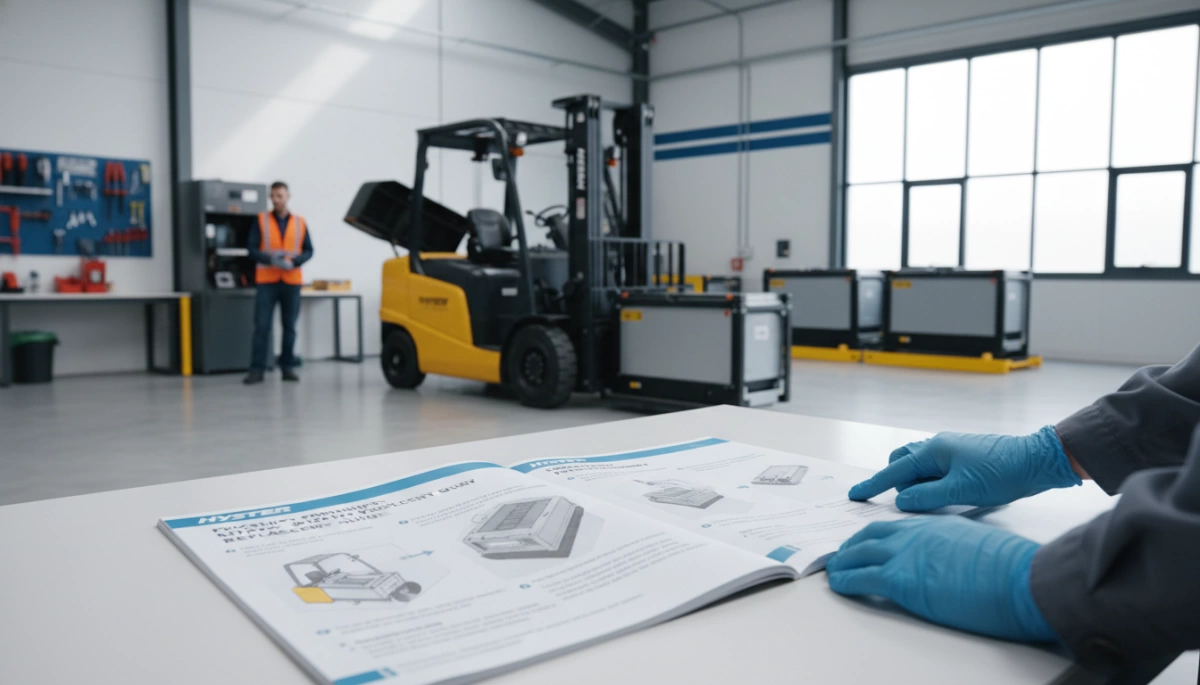
Picking the right Hyster forklift lithium battery replacement isn’t just “24V vs 48V”. If you get the sizing, BMS, and charger wrong, you’ll fight errors and downtime. Get it right and you get longer runtime, fast charging, and stable performance.
Match Voltage and Capacity (24V / 36V / 48V)
First, match what your truck is built for:
- Common Hyster voltages:
- Pallet jacks / small stackers: 24V
- Some reach trucks / mid-size: 36V
- Most counterbalance and larger electrics: 48V
- Match or slightly increase Ah / kWh compared with your lead-acid:
- Same Ah = similar runtime, plus efficiency gain from lithium
- Higher Ah = longer runtime, but check weight and space
Rule of thumb: check the Hyster nameplate and your current battery label, then choose a lithium option with matching voltage and equal or higher usable kWh.
Measure the Battery Compartment for Drop‑In Lithium
Hyster battery compartments are tight. Always measure:
- Length, width, height inside the battery box
- Cable exit location and connector type (DIN, SB, etc.)
- Required minimum weight (counterbalance stability)
Then choose a drop‑in lithium battery with:
- Exterior dimensions within those limits
- Proper placement of the connector to avoid cable stress
- Weight that meets or includes ballast to match Hyster specs
Quality suppliers of industrial LiFePO4 batteries for Hyster lift trucks design packs as true drop-ins, including counterweight and enclosure; you can see examples in the lithium forklift range on Xichá Battery’s industrial lithium solutions.
BMS Features for Hyster Forklift Lithium Batteries
The BMS (Battery Management System) makes or breaks the upgrade. For Hyster forklift lithium ion battery upgrades, look for:
- True LiFePO4 chemistry (safety + long cycle life)
- CAN bus / RS485 support for Hyster communication where available
- Protections: over/under-voltage, over-current, short-circuit, high/low temp
- Cell balancing for long-term capacity retention
- Clear SOC (state of charge) display or app monitoring
- Event logging and error codes to simplify diagnostics
If your fleet runs J-series or E-series trucks, a Hyster-compatible BMS with CAN bus integration helps avoid nuisance derates and false error codes.
Charger Compatibility and Lithium Forklift Chargers
You can’t just plug a lithium pack into an old lead‑acid charger and hope for the best.
- Use a dedicated Hyster forklift lithium battery charger with:
- Correct output voltage and current
- Lithium‑specific charge profile (no equalize, no long float)
- If reusing a charger:
- Confirm it’s lithium-capable and can be reprogrammed
- Match connector type and charging current to the new pack specs
A good lithium supplier will match battery + charger as a complete kit so your operators can opportunity charge safely across shifts.
Compatibility with Hyster E-Series, J‑Series, and Electric Lift Trucks
Most Hyster electric forklifts (E-series, J-series, reach trucks, pallet jacks) can be upgraded if you:
- Match voltage, dimensions, and weight
- Use a BMS that doesn’t conflict with Hyster truck controls
- Validate error code behavior and truck derate thresholds after install
Ask the supplier directly which Hyster models they’ve already tested (e.g., J1.6–J3.5, E-series narrow aisle, reach trucks, pallet trucks). Proven compatibility cuts your risk.
Integrated Lithium vs Drop‑In Lithium Packs
You’ve got two main routes:
-
Factory-integrated lithium (from Hyster):
- Clean integration, OEM software support
- Higher upfront cost, less flexibility in supplier choice
-
Aftermarket drop‑in LiFePO4 packs:
- Often better $/kWh and more spec options
- Can retrofit older fleets and mixed models
- Requires a supplier who understands Hyster CAN bus, charging, and safety
For many global fleets, a premium aftermarket drop-in lithium battery for Hyster models delivers the best mix of cost, performance, and flexibility.
Why Choose a Premium Lithium Brand for Hyster Forklifts
Going cheap on lithium is the fastest way to get truck faults and downtime.
A premium Hyster forklift lithium battery should offer:
- Verified cycle life (3,000–4,000+ cycles at 80% DoD)
- Certified safety (UL/CE/UN38.3, etc.)
- Rugged industrial enclosure for harsh warehouse and dock use
- Matched chargers and support for Hyster integration
- Strong warranty and fast tech support when issues pop up
When I spec batteries, I always prioritize proven industrial lithium packs from manufacturers that specialize in forklifts and have experience with Hyster warehouse forklift lithium conversions, similar to what’s offered by established suppliers like Xichá’s lithium forklift battery solutions.
Tools and Safety Precautions for Hyster Forklift Lithium Battery Replacement
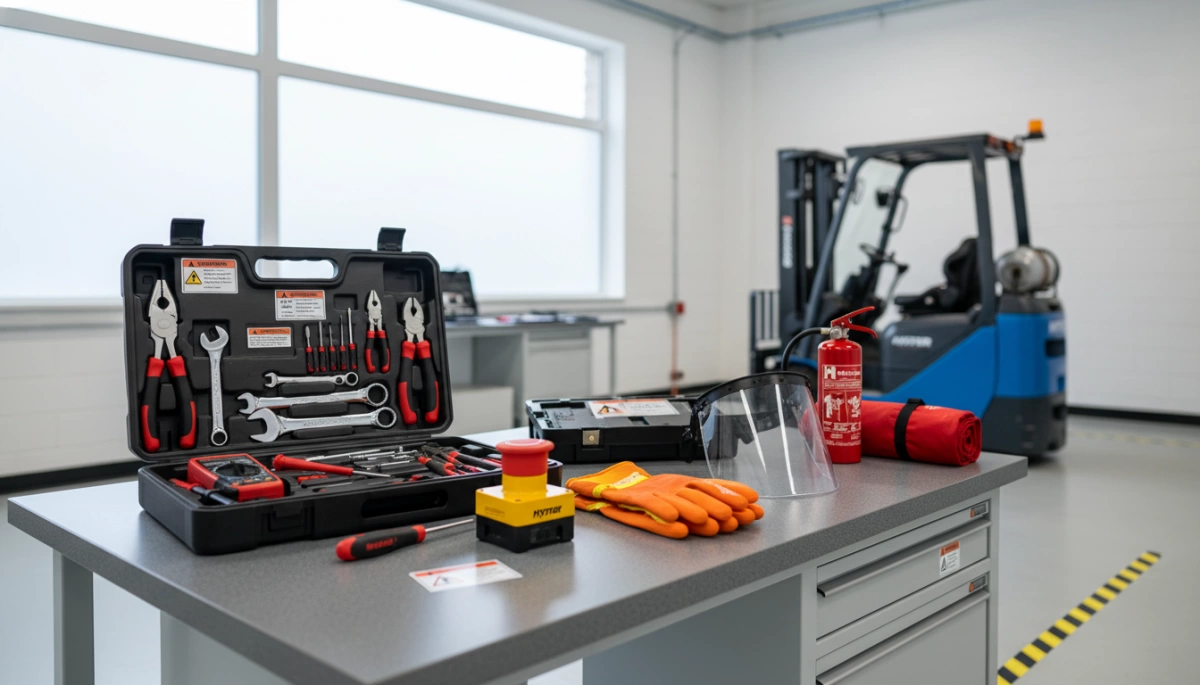
Swapping a lead-acid pack for a lithium battery on a Hyster forklift is not hard, but it is high-risk work if you’re careless. Here’s what I actually insist on for a safe, clean Hyster forklift lithium battery replacement.
Essential tools for Hyster battery removal and installation
Have the right tools ready before you touch the truck:
- Insulated socket set and spanners (metric/imperial, depending on your Hyster model)
- Torque wrench for tightening lithium battery terminals to spec
- Battery lifting beam or spreader bar suitable for Hyster battery compartments
- Overhead crane, pallet stacker, or rated forklift for lifting heavy packs
- Multimeter for basic voltage checks and confirmation of power isolation
- Plastic cable ties and cable clamps for securing harnesses and CAN/communication lines
- Non-conductive cleaning brush and rags for cleaning the battery tray and contacts
- Labeling tags/markers to mark positive/negative cables and Hyster connector positions
With lithium upgrades, I always keep manufacturer documentation and the Hyster wiring diagram on hand.
Required PPE for forklift battery work
For any Hyster forklift battery work—lead-acid or lithium—PPE is non‑negotiable:
- Insulated gloves rated for electrical work
- Safety goggles or face shield (protect from sparks or debris)
- Safety shoes with toe protection (batteries are heavy, toes are not)
- Long sleeves and long pants (protects from sharp edges and old acid residue)
- Insulated hand tools only—no bare metal tools near live terminals
If you’re removing an old lead-acid Hyster battery, add acid-resistant gloves and apron in case of leaks.
Lockout/tagout and power isolation on a Hyster forklift
Before starting the Hyster forklift lithium ion battery upgrade, lock the truck out properly:
- Park on level ground, lower forks to the floor, engage the parking brake.
- Turn the key OFF, remove it, and tag the truck as “Out of Service.”
- Disconnect the main battery connector (Hyster Anderson-style plug or OEM connector).
- If fitted, open the battery disconnect switch or main breaker.
- Wait a few minutes for capacitors to discharge, then verify with a multimeter that:
- No voltage is present at the main truck cables.
- No live voltage on the chassis or exposed contacts.
No lockout/tagout, no work. This is where shortcuts get people hurt.
Safe handling of heavy forklift batteries and lifting equipment
Hyster lead-acid packs are extremely heavy; even many lithium packs are no joke. Handle them like a load, not a component:
- Check the battery weight and lifting capacity of your crane/forklift first.
- Use certified lifting points on the battery case (never under the cables or BMS box).
- Keep hands and feet clear of pinch points when sliding the battery in/out.
- Move slowly—no swinging loads or fast turns.
- Never allow anyone under a suspended battery.
- Use guide ropes or spotters to steer heavy batteries into Hyster battery compartments.
If you don’t have rated lifting gear, don’t improvise—bring in someone who does.
Lithium-specific safety and fire risk awareness
Lithium batteries are safer and cleaner than lead-acid when used correctly, but they behave differently in a failure:
- Only use a LiFePO4 industrial lithium battery approved for Hyster forklifts and motive power.
- Never open the lithium battery case or bypass the BMS. If the pack is damaged, remove and quarantine it.
- Watch for signs of damage: dents, punctures, strong chemical smell, smoke, or excessive heat—do not charge or use.
- Keep a Class D or lithium-capable fire extinguisher nearby, plus a clear escape path.
- Do not place lithium batteries near open flames, welders, or hot surfaces.
- Follow the manufacturer’s charge voltage and current limits and use a proper Hyster forklift lithium battery charger.
If a lithium pack overheats or vents, evacuate the area and call emergency services—do not pour water directly onto a burning pack unless your local code and extinguisher type clearly allow it.
Work area preparation, ventilation, and no-spark rules
Set up the work zone before starting the Hyster forklift lithium battery replacement process:
- Work in a clear, well-lit, and ventilated area away from customer traffic.
- Remove metal jewelry, watches, necklaces, and keep metal tools off the battery top.
- Mark a no-smoking / no open flame / no welding zone around the work area.
- Keep the floor dry and clean—no oil, water, or debris underfoot.
- Use non-conductive mats or boards if you’re working in a tight metal-bay area.
- Keep only necessary staff in the work area and give one person responsibility for safety control.
Once the space is clean, controlled, and quiet, then you start the actual Hyster forklift lithium battery swap.
Step-by-Step Hyster Forklift Lithium Battery Replacement
Upgrading a Hyster forklift from lead-acid to a lithium battery is straightforward if you follow a clear process. Here’s how I handle a Hyster forklift lithium battery replacement safely and efficiently.
Preparation: Park, Secure, Power Down
Before touching anything on the truck:
- Park on flat ground, forks down, parking brake fully applied
- Turn key OFF and remove it
- Disconnect any attachments (chargers, accessories, clamps, etc.)
- Add lockout/tagout on the key switch or main disconnect so no one powers the Hyster truck up while you’re working
Safely Disconnecting the Old Hyster Battery
Sequence matters when you replace a lead-acid with a lithium forklift battery:
- Verify the charger is unplugged from the truck
- Open the battery compartment / side gate
- Confirm voltage with a meter (no live charger connected, no abnormal voltage)
- Disconnect the negative cable first, then the positive
- Isolate cables so they can’t touch each other or the frame
- Note or label the main connectors, sense wires, and any Hyster Power Cellect / CAN bus cables
Removing the Lead-Acid Battery From the Compartment
Lead-acid batteries in Hyster forklifts are heavy and awkward:
- Use a rated pallet jack, hoist, or overhead crane – never “muscle it” by hand
- Use the designed lifting points or battery lifting beam
- Roll or lift the battery straight out of the Hyster battery compartment to avoid catching cables
- Move the old battery to a designated battery storage/recycling area immediately
Cleaning and Inspecting the Compartment and Cables
Before installing the lithium battery for your Hyster forklift:
- Vacuum or brush out debris, dust, broken plastic, and corrosion
- Wipe surfaces with a mild cleaner; remove any acid residue if the old battery leaked
- Inspect:
- Main cables for cuts, stiff insulation, burns
- Connectors for pitting, melted plastic, loose pins
- Ground points for tight, clean contact
- Replace any damaged cables or connectors now – don’t “hope” they’ll be fine
Fitting and Securing the New Lithium Battery
A drop-in lithium battery must sit correctly in the Hyster box:
- Confirm the battery dimensions match the Hyster battery compartment
- Check voltage (24V / 36V / 48V) and capacity match your truck spec
- Lower the lithium pack in slowly and centrally, keeping it square
- Use factory hold-downs, brackets, or shims so the battery can’t move during turning or braking
- Make sure the cables can route cleanly without pinching when the compartment is closed
Connecting Lithium Cables and Torquing Terminals
Clean, tight connections are key to lithium performance:
- Confirm polarity: positive to positive, negative to negative
- Connect any Hyster-compatible CAN bus / BMS communication plug (if provided)
- Use insulated tools and torque terminals to the manufacturer’s spec
- After tightening, check:
- No exposed copper
- No loose lugs or twisting cables
- Cable routing clear of sharp edges and moving parts
Configuring Charger, BMS, and Hyster Controls
To finish the Hyster forklift lithium ion battery upgrade:
- Set or replace the forklift charger to a lithium profile for that battery (LiFePO4, voltage, current limit)
- If the truck has Hyster Power Cellect or lithium-ready software, follow the setup steps:
- Select battery type = lithium
- Confirm SOC display is reading correctly
- Verify derate and protection settings are active
- Confirm the BMS has no active errors and that the truck displays normal status
Initial Startup, First Charge, and Test Drive
Once wired and configured:
- Reconnect the main connector and turn the key ON
- Watch for dash warning lights or error codes
- Perform a slow lift/drive test:
- Lift a pallet
- Drive forward and reverse
- Check for normal acceleration and no derating
- Plug in the Hyster forklift lithium battery charger and complete a controlled first charge
- Review the SOC, voltage, and temperature readings to make sure everything looks stable
Notes for Different Hyster Models and Battery Boxes
Different Hyster electric lift trucks need slightly different handling:
- Hyster J series / E series / reach trucks often have low-profile, side-removal battery boxes – verify the tray style and connector orientation
- Some factory lithium-ready Hyster models have pre-installed communication cables and brackets – use the OEM provisions instead of improvising
- For pallet jacks and stackers, lithium packs are often smaller drop-in modules with integrated chargers or simple connectors – follow the specific manufacturer instructions
Follow this process and you’ll get a safe, clean Hyster forklift lithium battery replacement that runs reliably, charges faster, and cuts downtime across your fleet.
Post-Replacement Charging and Maintenance for Hyster Lithium Batteries
Once you’ve done your Hyster forklift lithium battery replacement, the real gains come from how you charge and look after the pack day-to-day. Here’s how I run lithium fleets to keep uptime high and costs low.
Best Charging Practices for Hyster Lithium Forklift Fleets
For Hyster forklift lithium-ion battery upgrades, I keep it simple:
- Charge whenever the truck is idle – breaks, shift changes, loading delays
- Keep state of charge (SOC) between ~20–90% for best life
- Use a Hyster forklift lithium battery charger or a charger that’s approved by the battery brand
- Avoid leaving the battery at 0% or parking at 100% for days
For multi-shift Hyster operations, I usually set up fast chargers near high-traffic areas so operators plug in often instead of running batteries to empty.
Opportunity Charging vs Full Cycles on Lithium Forklifts
Lithium loves opportunity charging; lead-acid doesn’t. For Hyster electric lift trucks:
-
Opportunity charging
- Plug in during short breaks (10–30 minutes)
- Best for multi-shift Hyster fleets
- Keeps runtime high and heat low
-
Full cycles (0–100%)
- Fine occasionally, especially after install or firmware updates
- I avoid full discharge unless the manufacturer asks for a calibration cycle
If you’re upgrading from lead-acid to a LiFePO4 battery for Hyster forklifts, train operators: “If you stop, you plug.”
Daily Checks and Lithium Battery Maintenance
Maintenance on a lithium battery for Hyster forklifts is minimal compared to lead-acid:
-
Daily
- Check SOC on the truck display
- Quick look for error codes or warning lights
- Confirm charger cables and connectors aren’t damaged
-
Weekly
- Visual check for loose terminals or damaged harnesses
- Wipe off dust, moisture, and debris on the case and connectors
No watering, no equalizing, no acid spills. That’s a big part of the ROI of a Hyster forklift lithium-ion battery upgrade.
Monitoring SOC, Voltage, and Temperature
Most lithium forklift packs and newer Hyster E-series and J-series models support BMS data via:
- Truck display / dash – SOC, basic warnings
- Battery app (Bluetooth or Wi-Fi) – SOC, voltage, temperature, cycle count
- Telematics / fleet software – for bigger fleets
I tell operators to watch:
- SOC – don’t ignore low-SOC alarms
- Temperature – avoid running if the pack is too hot or too cold, especially in cold storage
- Derate warnings – if the truck slows down, check BMS and controller messages before continuing
Protecting Lithium Battery Life
To extend the life of a Hyster forklift lithium battery replacement:
- Depth of discharge (DoD)
- Try to stay above 10–20% SOC
- Regularly running to 0% will shorten life
- Charge window
- Best long-term range: 20–90%
- Temperature
- Avoid charging in extreme cold unless the pack has built-in heaters
- Keep away from high ambient heat when parked and charging
These habits are what keep lithium packs running strong for thousands of cycles in real warehouses.
Warranty Basics and What Voids Coverage
Most premium lithium brands used in Hyster forklift lithium battery upgrades offer multi-year warranties based on years + cycle count. I always remind customers:
Common ways to void or weaken coverage:
- Using a non-approved charger or wrong charge profile
- Bypassing or tampering with the BMS
- Modifying the battery box or case without approval
- Running the pack in unapproved environments (extreme temps, outdoor exposure, etc.)
- Ignoring fault codes and continuing to run the truck
Keep the install report, charger spec, and serial numbers on file. That speeds up any claim if something goes wrong.
Troubleshooting Common Post-Upgrade Issues in Hyster Trucks
After a Hyster lithium forklift battery upgrade, these are the problems I see most often:
-
Truck won’t power on
- Check main disconnect, BMS on/off, and emergency stop
- Confirm polarity and that connectors are fully seated
-
Derating / slow performance
- Low SOC or BMS limiting output due to temperature or voltage
- Check for Hyster forklift battery error codes on the dash
-
Charger not starting
- Charger not set to correct lithium profile
- CAN bus or communication mismatch on “smart” systems like Hyster Power Cellect
- Fault in AC supply to the charger
-
Frequent BMS trips
- Overcurrent: truck parameters too aggressive, need software tuning
- Over/under voltage: running battery outside recommended SOC range
If basic checks don’t fix it, I call in a certified forklift technician who understands Hyster-compatible lithium BMS and CAN bus. It keeps both safety and warranty intact.
Handled right, a Hyster forklift lithium battery replacement doesn’t just cut maintenance; it tightens up your charging habits, boosts uptime, and stretches the total cost of ownership in your favor.
Cost and ROI of Hyster Forklift Lithium Battery Replacement
Upgrading to a Hyster forklift lithium battery replacement isn’t just a tech upgrade – it’s a numbers game that usually pays off fast if your trucks run hard.
Upfront cost: lithium vs lead-acid for Hyster forklifts
- Lithium typically costs 1.5–3x more upfront than a comparable lead-acid pack.
- But with lithium you don’t need a spare battery, battery room, watering gear, or swap labor.
- On most Hyster electric lift trucks, a quality LiFePO4 industrial pack plus a matched Hyster forklift lithium battery charger is a one-time system upgrade, not a constant replacement cycle.
If you’re comparing options or spec’ing a fleet, it’s worth looking at complete lithium solutions like the industrial LiFePO4 forklift batteries in our lithium forklift battery product range.
Operating cost savings: energy, labor, and maintenance
Lithium cuts operating costs in a few clear ways:
- Higher energy efficiency: you usually save 15–30% on electricity vs lead-acid.
- Labor savings: no watering, no equalization, no battery change-outs, less time chasing low-voltage trucks.
- Lower maintenance: fewer service calls, no acid cleanup, no corrosion repairs on Hyster battery compartments.
For customers running multi-site warehouses, these savings add up every quarter, not just at the end of the year.
Downtime reduction & productivity gains with lithium upgrades
A Hyster forklift lithium ion battery upgrade boosts uptime:
- Fast charging + opportunity charging = far fewer “dead truck” incidents mid-shift.
- Consistent power: no sluggish lift or travel speed at low state of charge.
- No battery swaps: operators stay on the truck instead of visiting a battery room.
Most fleets see more pallets moved per shift with the same number of Hyster trucks, or can run fewer trucks to get the same work done.
Payback periods: single-shift vs multi-shift fleets
- Single-shift / light duty: typical payback is 3–5 years, depending on energy prices and maintenance history.
- Two or three shifts / intense usage: payback can drop to 1.5–3 years thanks to:
- Removed spare batteries
- No swap labor
- No battery room and ventilation costs
- Less unplanned downtime
If your Hyster fleet is already rotating lead-acid packs every 3–4 years, lithium ROI is usually even stronger.
Total cost of ownership (TCO) over battery life
A quality Hyster forklift lithium battery (LiFePO4):
- Delivers 3–5x more cycles than standard lead-acid.
- Holds its usable capacity longer, so you keep full-shift runtime for years.
- Reduces hidden costs: charger replacements, cable repairs, connector burns, acid damage to Hyster trucks and floors.
Over a 8–10 year window, the total cost of ownership for lithium is usually lower than cycling through multiple lead-acid sets, especially in multi-shift or high-throughput warehouses.
Budgeting, financing & phased conversion strategies
You don’t have to convert your entire Hyster fleet overnight. Smart approaches we see global customers using:
- Start with the worst offenders: convert trucks with the most downtime or battery issues first.
- Target multi-shift units: fastest payback and clearest ROI.
- Mix cash and financing: use financing or leasing on higher-capacity packs, pay cash for lower-use units.
- Standardize gradually: move to a common lithium platform and charger family across your Hyster E-series, J-series, and reach trucks.
If you want to dig deeper into lithium forklift ROI trends and technical updates, we regularly share case-based insights in our lithium forklift battery blog and news section.
Hyster Forklift Lithium Battery Replacement Guide – FAQs
Model compatibility for lithium batteries in Hyster forklifts
Most Hyster electric models (E-series, J-series, reach trucks, pallet trucks) can be upgraded from lead-acid to lithium if you match:
- Voltage: 24V / 36V / 48V as per original truck specs
- Capacity: Similar or higher Ah / kWh than your current battery
- Dimensions & weight: Fits the battery box and keeps truck stability
If you’re unsure, send us the truck model, data plate photo, and battery label, and we’ll match a drop‑in lithium battery for Hyster forklifts from our dedicated forklift lithium battery range.
Factory-integrated vs aftermarket lithium systems
| Option | Factory-Integrated Lithium | Aftermarket / Drop‑in Lithium |
|---|---|---|
| Installed by | OEM / dealer | Lithium supplier / fleet tech |
| Integration | Deep CAN bus + display integration | CAN or analog, model-dependent |
| Upfront cost | Higher | Usually lower |
| Flexibility | Fixed spec | Custom sizing and features |
| Best for | New trucks, big fleets | Upgrades of existing Hyster units |
Both work well; I usually recommend aftermarket LiFePO4 for fast ROI on existing trucks.
How long does a Hyster lithium battery replacement take?
Approximate time per truck:
- Simple drop‑in swap: 1–3 hours
- With charger upgrade & CAN integration: 3–5 hours
- Full fleet rollout (standardized models): 4–8 trucks/day with a trained team
Most customers schedule swaps during off-shift or weekends to avoid downtime.
When should you hire a professional forklift technician?
Bring in a pro if:
- You’re not trained for high‑voltage work
- The truck uses CAN bus integration / advanced BMS
- You need to protect OEM warranty & CE/UL compliance
- You’re upgrading chargers and site power at the same time
For multi‑truck projects, we typically send or coordinate a certified lithium forklift technician to keep everything safe and compliant.
Impact on warranty, certifications, and safety compliance
- Truck warranty:
- New trucks: use approved lithium systems to avoid conflicts.
- Older trucks: warranty may already be expired, but follow OEM specs anyway.
- Battery warranty:
- Lithium packs usually carry 5–10 year warranties if installed and charged correctly.
- Certifications:
- Make sure the lithium system holds proper UN38.3, CE, UL or regional approvals.
- Safety:
- Follow ISO/EN and local electrical and workplace safety rules; log every forklift battery swap lithium vs lead acid for audits.
If you want a compliant solution, we design our packs to match industrial lithium battery standards for Hyster lift trucks and documented safety procedures.
What to do with old lead-acid batteries after removal
Never store or scrap them casually. Do this instead:
- Send to a licensed recycler – lead-acid is almost 100% recyclable
- Get disposal certificates for environmental audits and ESG reporting
- Follow local hazardous waste rules for transport and storage
- Don’t open, drain, or “DIY recycle” old batteries
If you need help setting up a lithium upgrade plus take-back of old batteries, reach out to us through our battery upgrade consultation page on the contact us section.
Crown Reach Truck Lithium Battery Replacement Guide